
The People’s Armed Forces Maritime Militia (PAFMM, 中国海上民兵), the People’s Republic of China (PRC)’s “Third Sea Force” (中國的第三海軍), serves a critical role in Beijing’s calculus regarding “unification” with Taiwan. The militia is particularly valued for its capability to transition between peacetime and wartime operations (平战转换). More specifically, in PRC’s southeastern Fujian province, the PAFMM enables maritime quarantine: a low-kinetic contingency scenario that bridges both gray-zone operations and conventional military escalation.
The January 2026 “Floating Wall”
In January 2026, an L-shaped vessel array composed of thousands of Chinese fishing boats temporarily blocked the Taiwan Strait. It extended for approximately 300 miles and disrupted commercial activities and maritime transportation for over 30 hours. Coordinated by the provincial PAFMM of Fujian and Zhejiang provinces, the array consisted predominantly of fishing vessels from those two provinces. (Editor’s note: For analysis and graphics of past barrier formations of PAFMM vessels produced by the New York Times, see here.) In addition to PAFMM assets, these two coastal provinces host critical PLA bases, brigades, and the Eastern Theater Command, as well as dual-use military assets that constitute the PRC’s critical entities involved in a Taiwan contingency.
The floating barricade represented an unprecedented mass mobilization of civilian vessels. It was believed to be a simulation for potential future quarantines or blockades, signaling the maritime militia’s mobilizational readiness and political resolve: civilian vessels registered under PAFMM can quickly form a maritime barricade, establish a quarantine zone, and escalate a gray-zone scenario into a more serious contingency.
Rationale Behind a Maritime Quarantine
An amphibious assault on Taiwan would entail extraordinarily high costs, due not only to personnel and logistical requirements, but also to political pressure from both international and domestic audiences. By contrast, quarantine and blockade operations have significantly lower operational costs. [1]
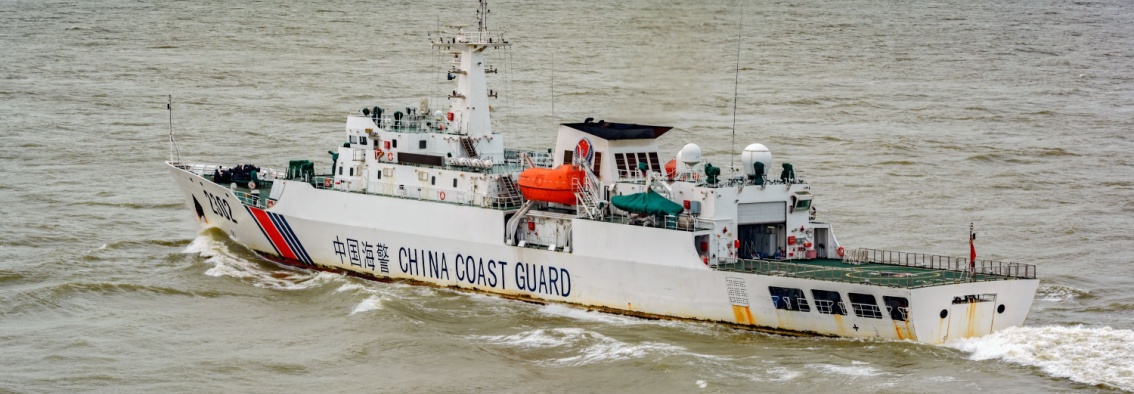
On the one hand, a quarantine scenario relies on both the legal ambiguity caused by Taiwan’s international status and the PRC’s own declared legal frameworks. The PRC claims that Taiwan is a province of the PRC, thus authorizing state-sponsored local actors (such as PAFMM vessels and militia) to execute tasks to enforce unification. On the other hand, a blockade is generally considered a state-versus-state action—involving state forces, such as the People’s Liberation Army Navy (PLAN, 中国人民解放军海军) and the Chinese Coast Guard (CGG, 中国海警局). [2] China’s past military exercises, including the Joint Sword series (see here and here) and the April 2025 Strait Thunder exercise, have demonstrated this pattern whereby the PLAN and CCG jointly execute a blockade simulation (e.g., against Kaohsiung Port).
Despite these differences, both quarantine and blockade operations interrupt civilian maritime activities. In a quarantine scenario, international actors are less likely to interfere (as long as no casualties are incurred) and the operation offers greater flexibility and reversibility. Conversely, a blockade may trigger third-party intervention—including the United States and its regional allies, such as Japan and the Philippines. Thus, given its cost-benefit effects, a declared quarantine would be the most preferred option for the PRC.
In line with this, Taiwan’s Whole-of-Society Defense Resilience Committee (全社會防衛韌性委員會) conducted a tabletop military exercise (桌推) on June 25, 2026, centered on a scenario involving maritime coercion in certain waters surrounding Taiwan (台灣周邊部分水域). Significantly, this was the committee’s first tabletop exercise specifically focused on “high-intensity maritime coercion” (高強度海上脅迫). The scenario modeled phased escalation initiated by the PRC Coast Guard, which began with harassment around Taiwan and progressed to requirements that vessels entering and departing Taiwanese ports report through China’s International Trade Single Window (國際貿易單一窗口), followed by inspection (查驗), boarding and inspection (登檢), and detention or seizure (扣押). Eleven government ministries and agencies participated in the exercise, in which responses involving maritime and land transportation controls, material acquisition, and the security of supply reception and transfer were examined.
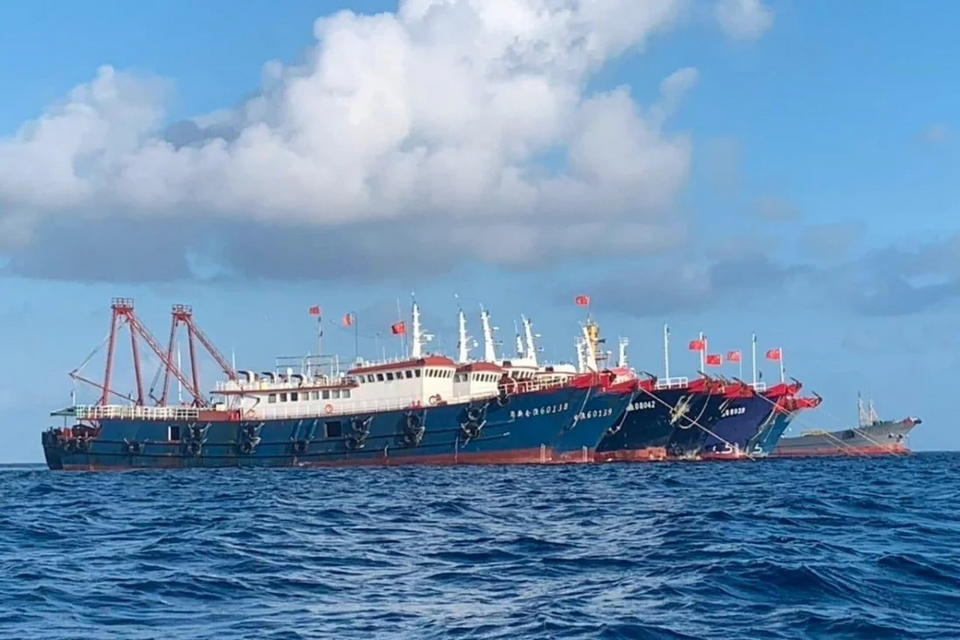
Image: PRC-flagged merchant vessels—evidently acting as maritime militia vessels—anchored in formation near Whitsun Reef in the South China Sea (March 2021). (Image source: Philippines Coast Guard / Wikimedia Commons)
Functions of the PAFMM in a Maritime “Quarantine” Scenario
The PAFMM serves multiple functions during a quarantine scenario:
(I) Enhancing intelligence, surveillance, and reconnaissance (ISR) activities before the quarantine;
(II) Gaining sea control;
(III) Assisting in the execution of quarantine-related tasks, including vessel interception and inspection; and
(IV) Signaling, supporting, and sustaining sea denial, and blocking vessels that attempt to interfere.
Vessels and maritime assets involved.
Four types of civilian vessels would be most likely to participate in the floating barricades for the quarantine: regular fishing vessels; roll-on/roll-off (RO-RO) ferries (heavy-duty transportation vessels that transport passengers); cargo ships; and other types of vessels, including passenger ships, tankers, and supply ships.
The fishing vessels are particularly useful due to their multiple functions in surveillance, as well as their number, availability, and operational flexibility. Fujian’s robust fishing industry can provide considerable logistics and personnel support for the PAFMM in a potential quarantine scenario.
According to the Fujian provincial government, at least 12,000 fishing boats (among which 7,000 are medium to large vessels) and approximately 22,6000 fishermen are formally registered under governmental records. The detailed number of fishermen officially registered under the PAFMM, however, is unconfirmed. Furthermore, the active presence and broader coverage of critical sea lines of communication (SLOCs) by these fishing vessels facilitate the efficient implementation of quarantine mobilization. The distance between Xiamen (Fujian’s major port city renowned for its deep-water port and two naval hubs) and Taipei is only 172.5 to 191 nautical miles (319 to 353 km). In contrast, Fuzhou, capital city and headquarters of the Eastern Theater Command Army, lies 115 to 160 miles (185 to 250 km) across from Taipei.
Moreover, the Taiwan Shoal (臺灣淺灘), a body of water located near the southern end of the Taiwan Strait, only allows smaller vessels to operate in it: in the sea area 30 nautical miles (55.6 km) southwest of Penghu (澎湖), it has an average depth ranging between only 8 and 40 feet (10 and 30 meters). Thus, fishing vessels are prioritized for quarantine measures in such shallow waters.
Regulations involved
Fuzhou City has explicitly implemented municipal regulations on civilian acquisition and contingency mobilization. The “Contemporary Regulations on Civilian Vessel Requisition and Crewmen Mobilization,” designed to”meet the needs during wartime and special circumstances during the regular time,” details institutional actors, procedures, and specific vessel types involved in the requisition process.
Regarding a maritime contingency, all vessels that can navigate through type II water bodies are mandatorily registered for acquisition. [3] Additionally, maritime machinery fishing vessels of more than 50 tons are also subject to mandatory acquisition. They must be registered under the provincial Defense Transportation Authorities (省国防交通管理机构) for “combat-readiness formation” (战备编队). The regulation further states that the “defense transportation authorities at the municipal, county, and district levels are responsible for the mobilization and requisition of civilian vessels within their respective regions.”
The Fuzhou City Regulation is a pioneering framework designed to support mobilization readiness. Similar municipal-level regulations from Zhangzhou, Xiamen, and Quanzhou have not been made public yet. Whether a unified, provincial-level mobilization regulation would be unveiled and available remains unknown.
Tech Platforms and communication networks involved: Civil-military integration in practice.
All registered fishing vessels in Fujian are required to incorporate the BeiDou Navigation Satellite System (BDS), a satellite navigation system developed by the China National Space Administration. The BDS interoperates with GPS, providing consistent real-time location, positioning, and timing of fishing vessels and crews. Local regulations mandate that fishing vessels ensure the continuous operation of the BDS on a 24-hour basis.
In addition, all fishing vessels must be equipped with the Automatic Identification System (AIS). Compatible with a 9-digit ID issued by the managing and operational system of the Chinese Fishery Administration Command System, the AIS allows vessels to exchange real-time navigational data—including ID, position, course, and speed- making this valuable for fast mobilization and operational coordination during a contingency.
In addition to manually calling the militia members, the notification process for regular communication and mobilization now relies heavily on “smart mobilization systems” (智慧动员系统) and mass SMS and messaging platforms. This communication system allows militia members to be notified by Application messages and texts. Meanwhile, Local PAFMM members and institutional actors are also connected through dual-use instant-messaging platforms, including WeChat and DingTalk. The platforms are managed respectively by two China-based technology corporations, Tencent and Alibaba. Both have been recently included on the US Department of Defense’s Section 1260H list. The Department identifies Tencent as indirectly affiliated with the PLA and Alibaba as a contributor to China’s defense industrial base through military-civil fusion, citing its affiliation with the Ministry of Industry and Information Technology (MIIT).
Taken together, the integration of the BeiDou system and commercially operated communications platforms into local mobilization mechanisms illustrates how civilian technological infrastructure can support military readiness. This arrangement reflects the PRC’s broader approach to military-civil fusion (军民融合), through which civilian technologies, infrastructure, and organizational resources can be incorporated into defense and mobilization requirements.
Countermeasures: Recommendations for Observers and Stakeholders
To effectively counter and detect the operations of the PAFMM during a quarantine scenario, the following recommendations should be followed by Taiwan.
First, Taiwan should use AI and drones for early warnings to increase maritime domain awareness in critical SLOCs, especially around the offshore islands closer to Fujian (e.g., Quemoy and Matsu). The 2026 National Defense Budget and the recently passed “Special Budget for Strengthening Defense Resilience and Asymmetric Capabilities” (強化防衛韌性及不對稱戰力計畫) have both provided the necessary frameworks, regulations, and appropriated resources. Despite the internal divisions in Taiwan’s Legislative Yuan, the 10 billion TWD procurement of AI-assisted C5ISR and the 335 billion TWD procurement of uncrewed systems and anti-defense systems provide a window of opportunity to develop such a strategy.
Second, Taiwan should continue to enhance intelligence-sharing cooperation with allies and partners (e.g., Japan and the Philippines) in PAFMM monitoring, allowing critical time for responses and coordination.
Third, the Taiwanese military should simultaneously focus on bolstering its cyber warfare capabilities to disrupt PAFMM communications.
Conclusion
The PAFMM will function as a core asset for the Chinese military in executing any quarantine scenarios directed against Taiwan, as its civilian assets and personnel serve as valuable instruments for sea denial and SLOC control. Moreover, through its role in gray zone activities, the PAFMM is also a valuable asset for the Chinese government to assert sovereignty over Taiwan. Thus, the PAFMM’s gray-zone operations will persist as the norm across critical SLOCs in the East and South China Seas, and potentially extend to the First Island Chain. In the context of U.S. -China maritime competition, the PAFMM is a relevant means for the PRC’s broader strategic ends: it functions as a force multiplier in expanding the PRC’s maritime interests, advancing the goal of becoming a maritime power while seeking unification with Taiwan.
The main point: A Taiwan contingency could begin with a lower-level kinetic scenario, such as a maritime quarantine. Fujian’s maritime assets and geographic proximity to critical SLOCs around Taiwan provide a foundation for such an escalation scenario; fishing vessels, PAFMM personnel, and other dual-use assets could therefore play a leading role in advancing China’s ultimate goal of unification with Taiwan.
[1] Both quarantine and blockade involve sea control and aerial denial, but different actors intervene and thus generate separate jurisdictional and political consequences. In a quarantine scenario, local actors operate alongside state forces to control domestic waters under internal law-enforcement authority. In contrast, a blockade involves state forces and may impact a larger body of water, including the exclusive economic zone, and may extend to the high seas beyond the 200 nautical miles. As a result, a blockade scenario may violate international law and lead to interference from other international actors.
[2] The Chinese Coast Guard is considered a state force.
[3] Fujian defines “Type II sea zones” as near-sea navigating zones, which include waters that fall within 10 nautical miles and 200 nautical miles from the shore.