
Introduction
On December 29 and 30, People’s Republic of China (PRC) military forces carried out a large-scale exercise in the air and ocean areas around Taiwan titled “Justice Mission-2025” (正义使命-2025). As announced at the outset of the exercise by the PLA’s Eastern Theater Command (东部战区), the drills would focus on “sea and air combat readiness patrols” (海空战备警巡), “seizing comprehensive superiority” (夺取综合制权), “blockading key ports and territory” (要港要域封控), and “three-dimensional external line deterrence” (外线立体慑阻) in the maritime region around Taiwan.
This represented the second major maritime exercise in 2025 [after April’s Strait Thunder-2025A (海峽雷霆-2025A) exercise] conducted by forces of the PRC’s People’s Liberation Army (PLA) around Taiwan. It continued an encirclement and blockade theme that first emerged clearly in the 2023-2024 “Joint Sword” exercises (see previous analyses here, here, and here). It also demonstrated a continuing propaganda-cum-political warfare emphasis in PRC military operations related to Taiwan—as well as an intended deterrent message directed against foreign powers that might render aid to Taiwan in the event of a major crisis.
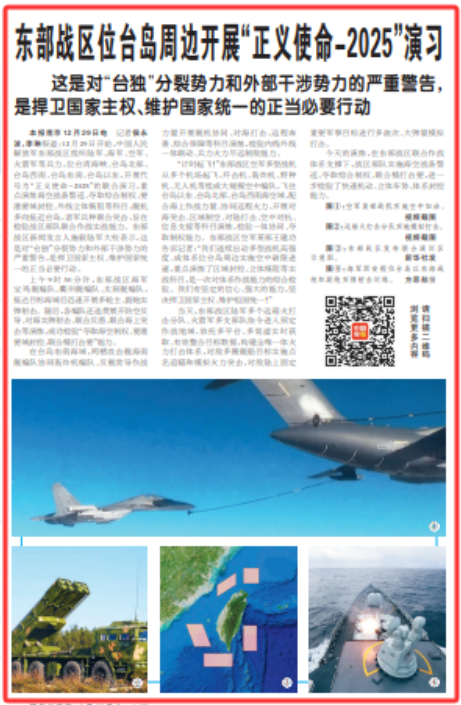
Image: A PLA Daily article about the “Justice Mission-2025” exercise (dated Dec. 30). The sub-header asserts that: “This Is a Stern Warning to ‘Taiwan Independence’ Forces and Foreign Interference Forces, and a Just and Necessary Operation to Defend National Sovereignty and Uphold National Unification.” (Image source: Zhongguo Junwang)
Tactical Military Activity in the Exercise
Publicly-available information on the specific operations conducted in the course of the Justice Mission-2025 exercise is limited. However, the Republic of China (ROC) Ministry of National Defense (MND) provided a press briefing that provided some specifics on exercise activity, in seven identified exercise areas around Taiwan. (See also accompanying graphic below.)
December 29
- The first day of the exercise saw the heaviest tactical air activity. There were a total of 130 sorties by PLA aircraft (not further delineated by type) directed towards Taiwan; of these, 90 sorties crossed the Taiwan Strait centerline.
- A total of 14 PLA Navy ships (not specifically identified by type or name) conducted operations in the vicinity of Taiwan. Of these, 11 ships “entered the adjoining [bordering] zone” (進入鄰接區)—a phrase that was not further defined by MND. [1]
- A total of 14 PRC Coast Guard ships (also not specifically identified) conducted operations around Taiwan or its outlying islands; of these, 8 ships “entered the adjoining zone.”
- A total of 4 ships from the “Western Pacific amphibious assault naval formation” (西太平洋兩棲攻击舰编队) operated together in an area approximately 85 kilometers (170 li) east/southeast of Taiwan. These ships were not further identified by the MND.
- A PLA publicity article dated December 26 appeared to indicate that the Yushen-class (Type 075) amphibious assault ship Hubei (湖北) (Hull 34)—the latest ship of the PLAN’s newest and largest class of landing helicopter assault (LHA) vessels—was involved in the exercise. The article stated that that “a certain amphibious vessel detachment composed of the Hubei and other ships” had deployed for “multidisciplinary combat training.”
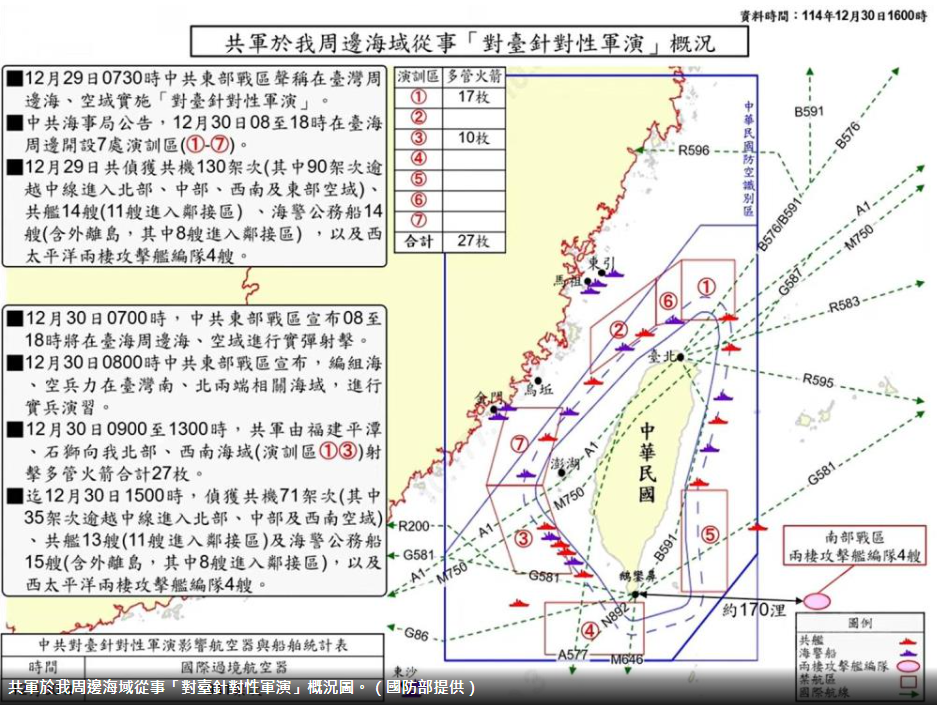
Image: A Taiwan government graphic depicting PLA military activity around Taiwan during the “Justice Mission-2025” exercise conducted on December 29-30. (Image source: ROC Ministry of National Defense)
December 30
- Per the MND, PLA exercise activity on the second day was broadly divided into three phases. The first of these occurred in the 0800 (8AM) hour, with live fire drills conducted by naval and air assets in sea areas to both the north and the south of Taiwan.
- The second phase, conducted from the 0900 to 1300 hours (9AM to 1PM) consisted of a series of long-range rocket firings from locations in Pingtan (平潭) and Shishi (石獅) in Fujian Province (福建省): 17 rockets that impacted in exercise zone #1 (north of Taiwan, and the port of Keelung), and 10 rockets into exercise zone #3 (west/southwest of Taiwan, and the port of Kaohsiung).
- The specific firing platforms were not identified, but likely were PHL-16 / PCL-191 Multiple Rocket Launcher System (MRLS) batteries operated by the PLA Ground Force (PLAGF), capable of firing guided rockets up to 280 kilometers.
- The MND indicated that a total of 10 rockets landed within the waters of Taiwan’s contiguous zone—making them, to date, the closest PLA projectiles to land near Taiwan’s coast.
- The third phase, commencing in the 1500 (3PM) hour, consisted of tactical air activity and continued naval drills. PLA air activity was significantly reduced on the second day, with a total of 71 sorties by PLA aircraft (not further delineated by type) directed towards Taiwan. Of these, 35 sorties crossed the Taiwan Strait centerline.
- A total of 13 PLAN and 15 coast guard vessels (not specifically identified) conducted operations in the vicinity of Taiwan. Of these, 11 PLAN and 8 coast guard vessels “entered the adjoining zone.”
- The 4 amphibious ships continued operations to the east/southeast of Taiwan. Per video on PRC state media, some of the personnel on these ships conducted drills involving infantry (possibly PLA Navy Marine Corps or special forces personnel) boarding helicopters for possible simulated raids and/or facilities seizure drills.
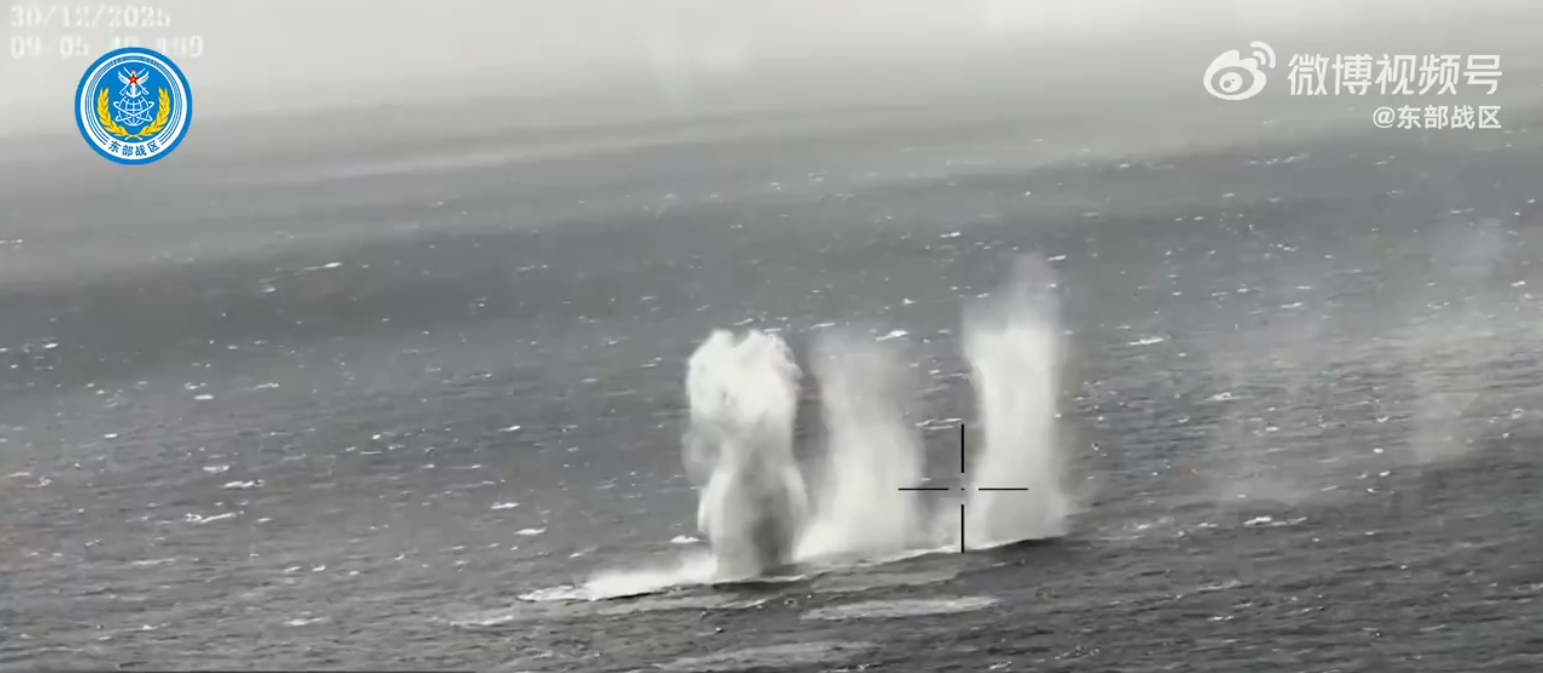
Image: PLA footage, from an unspecified platform, reportedly showing impacts of rockets fired into the sea off Taiwan’s coast (Dec. 30). (Image source: PLA Eastern Theater / Zhongguo Junwang)
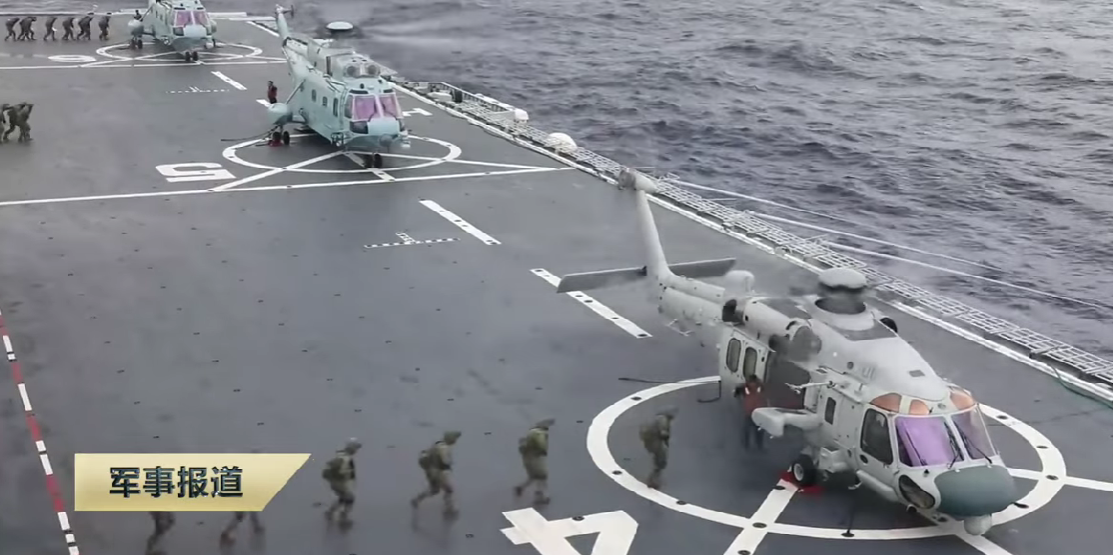
Image: An image from PRC state media of infantry (presumed PLA Navy Marine Corps personnel) boarding helicopters on an amphibious ship for a drill during the December 2025 exercise. (Source: CCTV)
Political and Propaganda Elements of the Exercise
As is always the case with PLA military exercises around Taiwan, the intended psychological and political warfare component is a primary factor—one that trumps even the practical military value of the exercise training evolutions. Accordingly, propaganda played a key role in the PRC government messaging surrounding the exercise (although in a less strident tone than observed earlier in 2025). At the outset of the exercise, the PLA Eastern Theater Command issued a statement that it represented a “stern warning against ‘Taiwan independence’ separatist forces and foreign interference forces, [and] is a legitimate and necessary action to defend national sovereignty [and] and uphold national unification” (这是对“台独”分裂势力和外部干涉势力的严重警告,是捍卫国家主权、维护国家统一的正当必要行动).
At the December 29 PRC Foreign Ministry press conference, spokesperson Lin Jian (林剑) linked the exercise with alleged “separatist” actions by the administration of Taiwan President Lai Ching-te (賴清德), as well as the mid-December announcement of the US Government approval of an $11.1 billion USD package of arms sales to Taiwan. Lin stated that:
The drills are a punitive and deterrent action against separatist forces who seek “Taiwan independence” through military buildup, and a necessary move to safeguard China’s national sovereignty and territorial integrity. Let me stress that to advance their separatist agenda, the DPP authorities are turning Taiwan into a powder keg. Their massive and desperate arms purchase further reveal [sic] their true nature as provocateurs, saboteurs of peace and war-mongers. Anyone who tries to arm Taiwan to contain China will only embolden the separatists and push the Taiwan Strait closer to the peril of armed conflict.
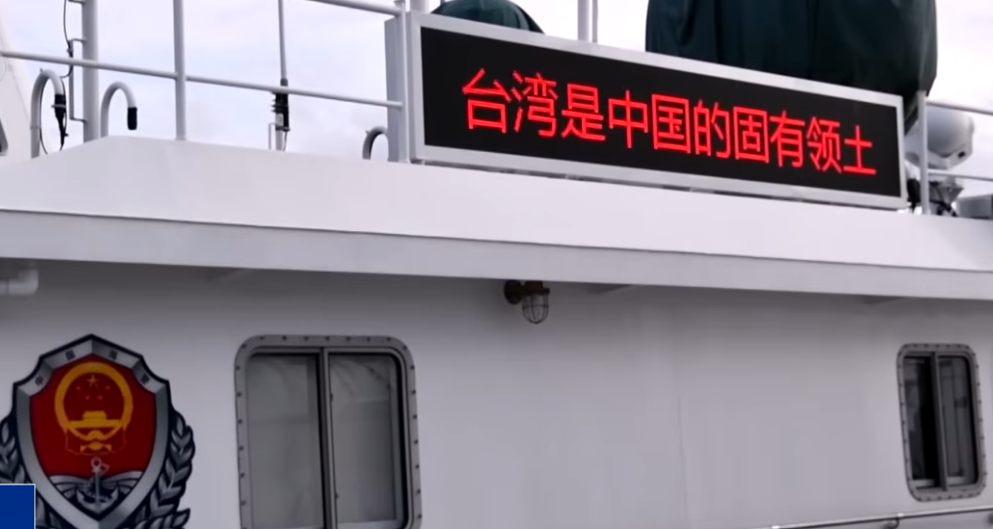
Image: “Taiwan is China’s inherent territory” (台湾是中国的固有领土) —a slogan displayed on a PRC Coast Guard vessel assigned to participate in the “Justice Mission-2025” exercise. (Image source: CCTV)
Taiwan’s Mainland Affairs Council (大陸委員會) (MAC) issued a December 29 statement that put the exercise in the context of the Chinese Communist Party (CCP)’s “provocative and coercive military actions” against Taiwan, and stated that the exercise:
[N]ot only seriously threaten[ed] the stability of the status quo across the Taiwan Strait, but also pose[d] a significant challenge to regional security, once again demonstrating that the CCP is the troublemaker undermining peace across the Taiwan Strait […] [The CCP] speaks of closer ties, yet on the other resorts to military intimidation; on the one hand, it proclaims that “people on both sides of the Taiwan Strait belong to one family,” yet on the other turns its military might against Taiwan. This once again demonstrates that the people of Taiwan must harbor no illusions about the CCP.
Regional governments have expressed concern over the exercise, in measured terms. For example, Japan’s government—which has been on the receiving end of a hostile PRC diplomatic campaign since early November—made a statement December 31 that the military drills “constitute actions that increase tensions across the Taiwan Strait,” and that “peace and stability across the Taiwan Strait are important for the international community as a whole.” US President Donald Trump downplayed the significance of the exercise, in comments that emphasized a personal relationship with CCP General Secretary Xi Jinping: “Well, I have a great relationship with President Xi, and he hasn’t told me anything about it. I certainly have seen it, but he hasn’t told me anything about it… and I don’t believe he’s going to be doing it.”
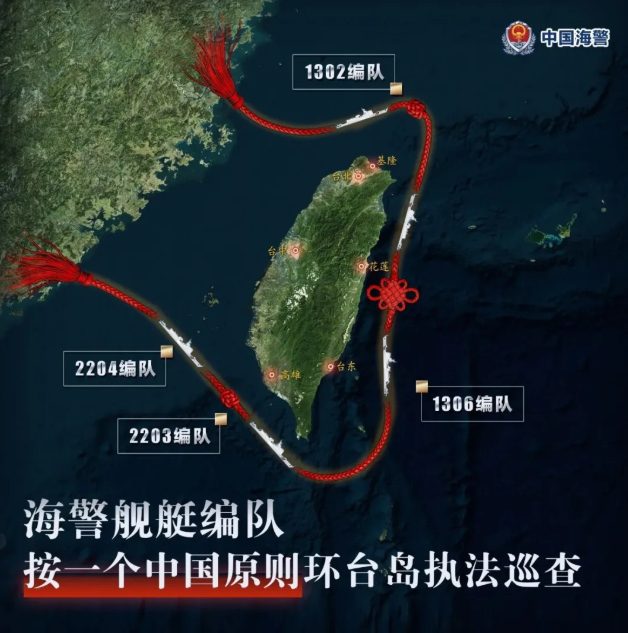
Image: A PRC propaganda graphic showing the location of PRC Coast Guard patrols around Taiwan during the exercise, depicting them as a traditional Chinese marriage knot. This continues a longer-term trend in the PRC’s “stalker” propaganda directed towards Taiwan, which attempts to depict menacing PRC actions as being affectionate in nature. (Image source: Beijing Today)
The customary New Year’s address for 2026 by CCP General Secretary Xi Jinping, released December 31, made no mention of the exercise. However, Xi did extol the PRC’s move in 2025 to create the “Commemoration Day of Taiwan’s Restoration” (台湾光复纪念日)—a further narrative effort to link China’s asserted sovereignty over Taiwan with victory in World War II. He also made a standard exhortation that “For cross-Strait compatriots, blood is thicker than water, [and] the historical trend of reunification of the fatherland cannot be stopped!” (两岸同胞血浓于水,祖国统一的历史大势不可阻挡!).
Conclusion: Distinctive Elements of “Justice Mission-2025”
There were a number of noteworthy aspects of Justice Mission-2025. The first of these is that no PLAN aircraft carrier deployed for the exercise, as has been the case in some other recent major exercises (such as Joint Sword-2024B in October 2024, and Strait Thunder-2025A in April 2025). (The PLAN carrier Fujian sailed through the Taiwan Strait on December 17, but this appeared to be a routine transit to a maintenance facility, and the vessel was not involved in the exercise.) However, based on the numbers reported by Taiwan’s MND, the exercise did feature a high-level of shore-based PLA aviation sorties.
In place of a PLAN aircraft carrier deployment to the east of Taiwan, the PLAN deployed a formation of four amphibious assault ships to the east/southeast of Taiwan. Such vessels possess rotary-wing, but not fixed-wing, aviation assets. Based on the limited information from PRC media, it appears that these ships conducted at least some rudimentary helicopter-borne training for embarked naval infantry personnel, but the specific content of such training is unclear. It is noteworthy, however, to see such training now being conducted by PLAN amphibious forces in the vicinity of Taiwan’s eastern coast.
PRC media also indicated that the exercise featured simulated strikes on targets in Taiwan by PLA aviation assets (a feature of some of the preceding Joint Sword and Strait Thunder exercises since 2023), although it is uncertain what the specific targets may have been. Far more provocative were the rocket live-firings into sea areas north and south of Taiwan—a step that is evocative (albeit on a much lesser scale) of the ballistic missile launches around Taiwan conducted by the PLA in August 2022. The willingness of the PLA to fire live projectiles into Taiwan’s contiguous zone is a significant step forward in its efforts to intimidate Taiwan’s population, and in the “boiling the frog” series of graduated moves intended to erode Taiwan’s maritime sovereignty.
The Justice Mission-2025 exercise also continued the encirclement / blockade theme that has been prominent in the PLA’s major exercises since at least the initial Joint Sword exercise of April 2023. Accordingly, these exercises have been characterized by naval and coast guard deployments around the periphery of the island, surges of aviation sorties, and occasional long-range rocket firings; but little in the way of significant coordinated activity by ground force amphibious units.
Arguably, the most significant aspect of the exercise was the declaration of exercise zones that were closer to Taiwan’s coastline, and which in some cases appeared to cross over into Taiwan’s contiguous zone (12-24 nautical miles from the coast). However, it is unclear whether any PLA units actually crossed into the contiguous zone around the main island of Taiwan (a prospect suggested, but not confirmed, by the MND’s comment on PLA units that “entered the adjoining zone”).
In connection with this, the PRC authorities also displayed a willingness in this exercise to be more disruptive of routine economic and travel activity: the declared exercise areas cut across major civil aviation corridors in Taiwan, and Taiwan’s government indicated on December 30 that 941 civil aviation flights had been affected, with media outlets reporting on disrupted flights and anxiety among many passengers.
The Justice Mission-2025 exercise also shared at least one noteworthy element in common with the large-scale, but unnamed, western Pacific exercise conducted by the PLA in December 2024. The latter exercise appeared to have been intended to send a deterrent message to regional powers that might intervene in a Taiwan military operation (particularly Japan and the United States). While the overall propaganda content of the December 2025 exercise was relatively restrained by PRC standards, the language regarding the most recently-announced series of US arms sales, and the language about “foreign interference forces” acting in tandem with “Taiwan independence separatist forces,” appears clearly directed as a warning to the United States and its regional allies. Furthermore, the assertion of “external line deterrence” directed against foreign military forces aligns with the central theme of the December 2024 exercise.
While it is possible that the announcement of the US arms sales may have had a minor impact on the scheduling of the exercise, one should treat with skepticism the implied assertion that the arms sale prompted this exercise: an exercise of such scale would be planned far in advance, with the CCP leadership perhaps waiting for a political trigger they could invoke as a narrative justification. Such a practice, intended to place the onus on others for the PRC’s provocative actions, is a staple of CCP political warfare.
All in all, the Justice Mission-2025 exercise appears to be broadly consistent, in terms of both military operations and narrative propaganda, with the PLA’s other major maritime exercises conducted around Taiwan since 2023. Such exercises serve the dual purpose of asserting CCP narratives regarding its sovereignty claims over Taiwan, while also building up the individual and institutional skill proficiencies that PLA military personnel might bring to bear in an actual conflict. However, with the possible exception of the Hubei amphibious surface group deployment, it does not appear that the PLA displayed any noteworthy new proficiencies in this exercise. As always, for both the CCP leadership and their PLA military tool, the political element of such operations is paramount.
The main point: PRC military forces conducted another major maritime military exercise around Taiwan at the end of December—the second named major exercise of 2025 directed at Taiwan. The exercise, titled “Justice Mission-2025,” followed the encirclement / blockade theme of other major exercises over the past 2-3 years—and was distinguished by high levels of aviation activity, the deployment of more advanced PLA Navy amphibious ships, and declared exercise operating areas that were closer to Taiwan’s contiguous zone. The exercise also included a significant political / propaganda component, with messaging directed against “Taiwan separatist forces” and Taiwan’s potential foreign allies.
[1] The phrase “entering the adjoining [or ‘bordering’] zone” (進入鄰接區) is not clearly defined by the MND. While it is unclear, this might mean approaching or entering Taiwan’s contiguous zone: the region recognized under customary maritime law as lying between 12-24 nautical miles from a state’s coastline (with territorial waters extending from the coast to 12 nautical miles). The ROC MND often employs such vague (and potentially obfuscatory) language in describing PRC military activity, for reasons that are not clear—but which could relate to a desire to preserve collection methods, and/or to sidestep political controversy.