
As Taipei continues to reel from renewed uncertainty following comments made by US President Donald Trump after his May 13-15 summit with Chinese Communist Party (CCP) Chairman Xi Jinping, Beijing has found a new cross-Strait pressure point to exploit: Taiwan’s outposts in the South China Sea.
In late May 2026, a China Coast Guard (CCG, 中国海警局) vessel sailed into the restricted waters of Pratas/Dongsha Island (東沙島), forcing Taiwan’s Coast Guard Administration (海巡署) to respond. Within the already-tense cross-Strait relationship, one incursion by a CCG vessel may not appear to be a severe escalation. However, this incident is not the only one to occur near Taiwan’s South China Sea outposts: this year, four CCG vessels have entered Dongsha’s restricted waters, on six occasions.
The People’s Republic of China (PRC) has deployed a number of different tactics to place coercive pressure on Taiwan’s presence in and around Dongsha. In the recent past, China has deployed oil exploration structures inside Dongsha’s exclusive economic zone. Between 2020 and 2025, China placed jackets, floating production storage and offloading units, and rigs in the area. In 2020, a resupply flight was blocked from entering Dongsha’s airspace by Hong Kong air traffic control. Hundreds of illegal Chinese fishing boats regularly enter Dongsha’s restricted waters for fishing. And in January 2026, a People’s Republic of China (PRC) reconnaissance drone flew over the island. (The drone flew outside the range of the island’s air defense systems, so it could not have been shot down had Taipei made that decision.)
When compared to how it acts against other countries in the South China Sea region—especially the Philippines—China has acted with relative restraint towards Taiwan in the region. However, in a new era of US-Taiwan relations—characterized by the greater uncertainty produced by Trump’s contradictory statements—Beijing may begin to further push against Taipei’s holdings in the South China Sea in an effort to further expand the coercion map—and to spread Taiwan’s defense resources thinner.
As Taiwan has seen through incursions into its air defense identification zone (ADIZ) around Kinmen and the centerline of the Taiwan Strait, one PRC vessel or aircraft can quickly become many.
What Happened in the South China Sea?
Amidst regular, daily, and simultaneous People’s Liberation Army (PLA), PLA Navy (PLAN), and CCG incursions around Taiwan and Kinmen, the coercion map has expanded to include the South China Sea. In late May, Taiwan’s Coast Guard Administration (CGA) detected CCG Vessel 3501 sailing towards the restricted waters of Dongsha. The CGA sent its own vessel, Taichung, to intercept and push out the CCG vessel. Indeed, this kind of incident has occurred countless times around different parts of Taiwan since President Lai Ching-te took office in 2024.
What separates this particular incident from the others is that the standoff lasted for over 30 hours—as revealed by the radio transcript of the back-and-forth between the two vessels that was released by the CGA. After being warned to sail away from Dongsha, the CCG vessel responded: “The People’s Republic of China has sovereignty and jurisdiction over the Dongsha Islands. Our ship is conducting a routine patrol mission; please do not interfere with our operations.” The Chinese response regarding its “sovereignty and jurisdiction” was an unusual step by the CCG.
The Taichung countered: “Your actions only show that China’s so-called ‘peace’ is a deception, and the international community will not support you. Do not undermine peace; instead, you should return and pursue democracy, which is the proper way to serve your country. You are instructed to immediately change course and leave our waters. Otherwise, our vessel will take necessary action in accordance with the law.”
In the context of the recent Trump-Xi summit, the message from the Taiwanese CGA ship reads like a veiled response to the US president’s statements about Taiwan. In an interview on Fox News after the summit, Trump warned, “I’m not looking to have somebody go independent. And, you know, we’re supposed to travel 9,500 miles to fight a war. I’m not looking for that. I want them to cool down. I want China to cool down.”
The Taichung statement is a public warning that it is not Taiwan, but rather China, that is seeking to escalate tensions and “undermine peace.” According to Joseph Wu (吳釗燮), Secretary General of the National Security Council, Beijing deployed over 100 vessels within the first-island chain from Japan to the Philippines after the Trump-Xi summit.
In this particular moment, it is more important than ever for Taiwan to publicize the aggressive military actions and gray-zone coercion carried out by the PRC. Taiwan must make its case that it is China raising tensions and causing trouble, in order to make the case that Trump should approve the arms package already authorized by Congress to properly defend itself against PRC incursions and aggression. This incident in the South China Sea is a microcosm of typical PRC actions against Taiwan. While it was just one vessel, this could mark the beginning of a new dynamic between China and Taiwan in the South China Sea.
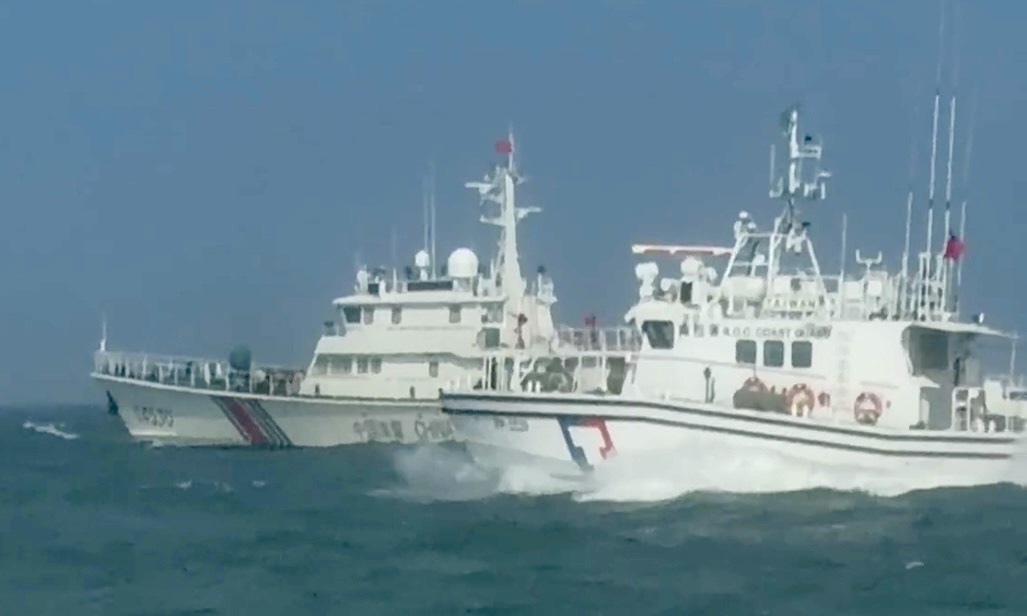
Image: A Taiwan Coast Guard vessel (foreground) confronts a PRC Coast Guard vessel (background) in restricted waters in the vicinity of Kinmen Island (May 26). The Chinese government is increasingly employing coast guard vessels for more aggressive patrols into the waters around Taiwan’s outlying islands—to erode Taiwan’s exercise of maritime sovereignty, and to portray such patrols as domestic law enforcement operations. (Image source: ROC Coast Guard Administration)
A Changing Status Quo is the New Status Quo
The recent PRC behavior in the South China Sea mirrors how PRC assets have, over the last several years, treated other maritime territories over which Taiwan exercises sovereignty. Indeed, the patterns of the PRC’s coercive escalation have become quite predictable.
First, the PLA, PLAN, or CCG slowly encroach on long agreed-upon or internationally-accepted lines, over the course of several months to a year—as, for example, they have done with the former Taiwan Strait centerline for military aviation. The goal of the first phase is to test Taiwan’s ability to detect and respond to the incursion. The testing phase also puts additional pressure on Taiwan’s defense resources by forcing them to respond to a new threat.
Second, after establishing a new status quo and level of acceptable behavior in the specific area, the PRC increases tensions by expanding its presence or moving deeper into Taiwan’s territory. This second step is often presented as a response to a political, economic, or diplomatic event viewed as advantageous to Taipei. Beijing uses these moments as a pretext for greater coercion towards Taiwan, casting its actions as necessary to protect China’s sovereignty. It also permits Beijing to cast itself as a victim. CCP narratives will also reject the concept of a historical or internationally-accepted demarcation, providing lawfare cover for these actions.
Third, Beijing chooses a specific moment to significantly escalate its actions in order to completely change the situation. This third phase is largely characterized by PLA, PLAN, and/or CCG assets flooding the zone to demonstrate its numbers and power vis-à-vis Taiwan. The goal of this phase is to show the people of Taiwan and worried partners that Taiwan stands no chance in the event of a contingency. The prospect of a fait accompli becomes the new status quo.
Fourth, Beijing maintains pressure at the levels from the third phase to analyze how much pressure Taiwan can handle. During this phase—the phase in which almost all PRC coercion now stands—Beijing and Taipei navigate a new status quo, wherein Taiwan learns new tricks to push back against China.
The situations in the ADIZ, around Kinmen, and at the centerline of the Taiwan Strait have all followed this pattern. The ADIZ incursions started small and escalated in response to high-profile Taiwan events. Beijing used the August 2022 visit by then-US House Speaker Nancy Pelosi to change the status quo and reject the long-established “Davis Line” in the middle of the Taiwan Strait (see here and here). Now, PLA, PLAN, and CCG assets operate with impunity almost anywhere they wish until Taiwan sends out the appropriate response. In February 2024, following an incident near Kinmen in which Chinese fishermen illegally fishing inside restricted waters died after their boat capsized while fleeing a Taiwan coast guard vessel, Beijing rejected the concept of Kinmen’s restricted waters and began sending CCG vessels into the area. Now, those vessels regularly patrol within Kinmen’s waters.
Understanding this pattern of coercion is important to predict how China may act in new locations to increase its pressure on Taiwan. At this point, there are few remaining locations where Beijing has yet to use its military or coast guard to apply coercive pressure. The South China Sea marks the most contentious remaining region in which China can pressure Taiwan. It is also an area in which the PRC already maintains a significant coast guard presence that it uses to coerce other countries.
It Is Time for Lai to Announce a New South China Sea Policy
The recent standoff at Dongsha between Taiwan’s and China’s coast guards highlights an important need for the Lai Administration: a South China Sea policy.
Throughout his presidency, President Lai has largely avoided mention of the South China Sea—even though Taiwan holds the two largest features in that region. Taiwan exercises sovereignty over Dongsha Island, where this incident took place, as well as Taiping Island (太平島), which is located further south in the South China Sea. Both islands are outfitted with docks and runways. However, the 2016 South China Sea ruling by the Hague downgraded the status of Taiping from “island” to “rock”—as it purportedly cannot sustain life.
Despite the prominence of the islands in the South China Sea security landscape, Lai did not bring them up in his inaugural address in May 2024. And since then, he has largely avoided the subject. The Lai Administration follows former President Tsai Ing-wen’s “four principles and five actions.” In its South China Sea Policy, the Tsai Administration emphasized that the multiparty dispute should be settled peacefully and include Taiwan, and all states should uphold freedoms of navigation and overflight despite their conflicting claims. To enforce its claims, the Tsai Administration promised to protect Taiwan’s fishing rights, engage in dialogue with all relevant parties, allow for international scientific research, and use Taiping as hub for humanitarian assistance and disaster relief in the region. This policy formula remains in place under the Lai Administration.
Considering the recent and lingering incidents occurring around Dongsha Island, and the fact that it has been 10 years since the president of Taiwan has released a policy (or even substantive statement) regarding the South China Sea region, now is the time for Lai to announce a new policy stance. One measure that the Lai Administration could take is to clarify its stance on the region’s features over which Taiwan does not exercise sovereignty. Taipei has already rejected the PRC’s expansive nine-dash line, through which it also claims sovereignty over Taiwan. However, the Lai Administration could renounce Taiwan’s historical claims to the rest of the Spratly Islands, Paracel Islands, and Scarborough Shoal. If that’s a step too far—giving up sovereignty claims over features that it does not control—then Lai can recommit to Taiwan’s peaceful, non-expansionist position in the entire region. Such a policy change would help to improve its bilateral relations with the other disputants, especially the Philippines. Lai can lead in the region by pledging to protect existing claims (i.e., Dongsha and Taiping) and ceding all other formal claims.
Indeed, Taiwan’s longstanding claims over the remainder of the Spratly Islands, Paracel Islands, and Scarborough Shoal in the South China Sea are not viable, and frankly do not reflect reality. Aligning policy, rhetoric, and resources would provide needed clarity and position Taiwan as a new leader in seeking to bring peace to a region blighted by conflict.
The main point: The recent China Coast Guard incident at Dongsha Island represents an expansion of China’s long-term coercion of Taiwan. The slow escalation in the South China Sea is starting to mirror Beijing’s traditional phased approach to coercion against Taiwan.