
In April 2024, Minister of Foreign Affairs of the People’s Republic of China (PRC) Wang Yi (王毅) held a public meeting with his Argentine counterpart, Diana Mondino, in response to months of speculation that Argentina and Taiwan might conduct a rapprochement. Prior to the meeting, reports had suggested that representatives from Taiwan were seeking to facilitate improved relations between Taipei and Buenos Aires. The Wang-Mondino meeting, held in Beijing, concluded with both governments reaffirming their mutual diplomatic positions: the PRC reiterated its support for Argentina’s claim over the Malvinas (Falkland) Islands, while Argentina reaffirmed its support for its One China policy and its recognition of “Taiwan as part of China.”
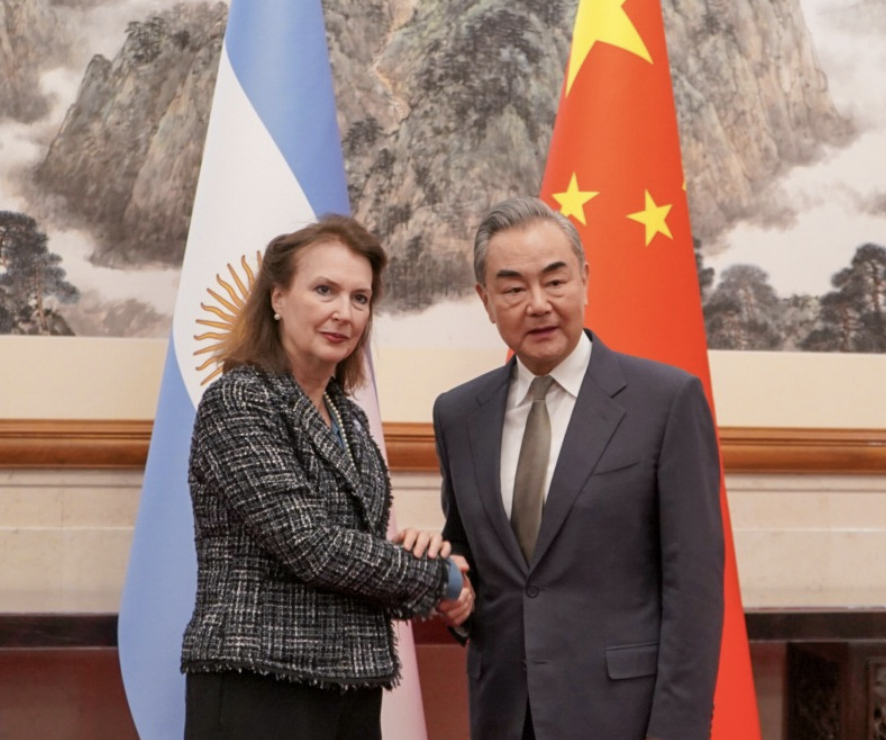
Image: Former Argentine Foreign Minister Diana Mondino meets with Chinese Foreign Minister Wang Yi in April 2024. (Image source: Argentine Ministry of Foreign Affairs)
This diplomatic exchange reflected a broader tendency in Argentine political and academic discourse to draw parallels between the Malvinas dispute—involving Argentina and the United Kingdom—and the question of Taiwan’s sovereignty. However, such comparisons often oversimplify the fundamentally different historical, legal, and geopolitical foundations of the two cases. Whereas the Malvinas dispute is framed by Argentina within the context of decolonization, the Taiwan issue emerges from competing claims of political legitimacy and contemporary great power rivalry in the Indo-Pacific. Despite these distinctions, support for one position is frequently portrayed by the PRC as necessarily requiring support for the other.
In this context, Beijing has been able to strategically leverage Argentina’s adherence to the One China principle in ways that reinforce its own diplomatic objectives. By framing support for Argentina’s Malvinas claim as part of a broader solidarity among Global South nations, the PRC has strengthened a narrative in which Argentina’s position on Taiwan becomes explicitly tied to continued Chinese political backing.
This article argues that the analogy between Taiwan and Malvinas is analytically flawed and diplomatically counterproductive. The comparison obscures the distinct nature of both disputes and limits Argentina’s ability to pursue pragmatic engagement with Taiwan in areas such as technology, trade, education, and human capital development. Strengthening unofficial ties with Taiwan would not require Argentina to abandon its Malvinas claim. Rather, greater engagement with Taiwan could provide economic and technological opportunities consistent with President Javier Milei’s emphasis on innovation, human capital formation; and could foster closer alignment with the United States and other like-minded partners.
The Malvinas: A Dispute Rooted in Colonial Succession and Uti Possidetis Iuris
Argentina’s position on the Malvinas claim is grounded in history and public international law: the inheritance of Spanish territorial rights following independence; the principle of uti posseditis iuris [1]; the exercise of government authority and control over the islands; and the Argentine government’s continuous protests against British occupation.
According to the Argentine National Archives’ maps, records, and government communiqués, the Malvinas formed part of the Viceroyalty of the Río de la Plata—an administrative unit encompassing Argentina as well—under Spain’s colonial administration. Following the 1810 Revolution and the 1816 Independence, Argentina inherited the territorial boundaries of the Spanish colonial administrative units from which it emerged, consistent with the principle of uti possidetis iuris. From this perspective, the Malvinas sovereignty claim derives from Argentina’s right to take up territories formerly under Spanish colonial control.
Additionally, Argentina exercised effective governmental authority over the islands after it gained independence. Between 1810 and 1833, the Argentinian government carried out administrative acts, appointed local authorities, and asserted jurisdiction over the territory. When British forces occupied Puerto Soledad on the Malvinas in 1833—gaining effective control over the islands—Argentina immediately protested the action and has maintained its claim through diplomatic channels ever since. Consequently, Argentina characterizes the British occupation as the interruption of its existing exercise of sovereignty.
Successive governments in Buenos Aires continued to pursue negotiations with the United Kingdom over the dispute. The 1976-1983 Argentinian military junta’s decision to occupy the islands on April 2, 1982, did not mark the beginning of Argentina’s sovereignty claim. Rather, the conflict with the United Kingdom—which ended with Argentina’s surrender after approximately two months of warfare—represented just one episode in a dispute that had existed for more than a century. Following the war, Argentina resumed its diplomatic efforts and has continued to raise the issue in international fora: including by the islands’ inclusion on the United Nations list of non-self-governing territories, and by rejecting British acts asserted as evidence of sovereignty.
Internationally, the dispute has been addressed within UN decolonization frameworks. The 1965 General Assembly Resolution 2065 acknowledged the existence of a sovereignty dispute between Argentina and the United Kingdom, and called upon both parties to pursue a peaceful solution through negotiations. The UN Special Committee on Decolonization continues to consider the issue, while the Organization of American States has likewise repeatedly characterized the matter as a sovereignty dispute and supported a negotiated settlement. As a result, the Malvinas question has for decades been embedded within an international legal and diplomatic framework centered on decolonization and the peaceful resolution of a bilateral sovereignty dispute.
Taiwan: A Different Historical and Legal Trajectory
The historical and legal circumstances surrounding Taiwan’s sovereignty differ fundamentally from those of the Malvinas. Instead of arising from an outright decolonization question, Taiwan’s status developed through a complex series of events: the fall of China’s Qing Dynasty, the Japanese colonial era and its collapse at the end of World War II, the Chinese Civil War, and the subsequent existence of two governments across the Strait after 1949.
Taiwan, historically known in the West as Formosa Island, was controlled by the Qing Empire and became a province in 1885. Following the Qing Empire’s defeat in the First Sino-Japanese War (1894-1895), the Empire ceded Taiwan and the Penghu Islands to Japan under the 1895 Treaty of Shimonoseki. After Japan surrendered in 1945 at the close of World War II, the Republic of China (ROC)—established in 1912 after the overthrow of the Qing Empire—assumed administrative control over Taiwan. The Chinese Civil War then culminated in the establishment of the PRC in 1949, with the ROC government relocating to Taiwan. Since 1945, the ROC has continuously exercised effective governmental authority over Taiwan and the islands under its administration.
Accordingly, Taiwan’s circumstances differ fundamentally from those of the Malvinas. Argentina’s claim is based on arguments concerning colonial succession, inherited territorial rights, and the alleged interruption of an existing exercise of sovereignty following the British occupation in 1833. By contrast, since its founding in 1949 the PRC has never exercised effective governmental control over Taiwan. Consequently, the issue is not analogous to the Malvinas case, which concerns the Argentinian government’s loss of its pre-existing administration of the islands to a colonial power.
Within international legal frameworks, Taiwan likewise occupies a different position. It has not been treated by the United Nations as a decolonization question. Rather, the 1971 General Assembly Resolution 2758—frequently pointed to by Beijing as the basis for its territorial claim to Taiwan—merely resolved the question of which government would represent “China” at the UN by recognizing the representatives of the PRC as “the only lawful representatives of China” to the organization. However, the resolution did not mention Taiwan, nor did it address Taiwan’s territorial sovereignty. Therefore, the issue of Taiwan is fundamentally different from the decolonization framework that has long defined the Malvinas dispute.
The PRC’s Strategic Use of the Taiwan-Malvinas Analogy
The aforementioned context demonstrates why equating Taiwan and the Malvinas is flawed. Treating the two cases as analogous conflates distinct historical processes and legal questions.
This is particularly relevant in Argentina’s relations with Taiwan. Buenos Aires officially recognized the PRC in 1972, a decade before the 1982 war with the United Kingdom, and has not maintained formal diplomatic relations with Taiwan since then. Nevertheless, both countries have longstanding economic, commercial, and cultural relations through representative offices in Taipei (Oficina de Representación Comercial y Cultural en Taiwan) and Buenos Aires (Taipei Economic and Cultural Office in Argentina, 駐阿根廷台北商務文化辦事處).
However, Beijing has taken advantage of the Malvinas dispute through diplomatic messaging centered on anti-colonialism, sovereignty, and Global South solidarity. PRC discourse frequently emphasizes shared historical experiences of foreign intervention and national humiliation, framing support for Argentina’s Malvinas claim as part of a broader partnership among developing nations resisting Western dominance. This narrative has proven politically influential within Argentina, as it links continued PRC support for the Malvinas claim to Argentina’s adherence to its One China policy and its avoidance of deeper engagement with Taiwan. By presenting the two issues as parallel questions of territorial integrity, the PRC advances a comparison that serves its diplomatic interests—despite the significant historical and legal differences between the two cases.
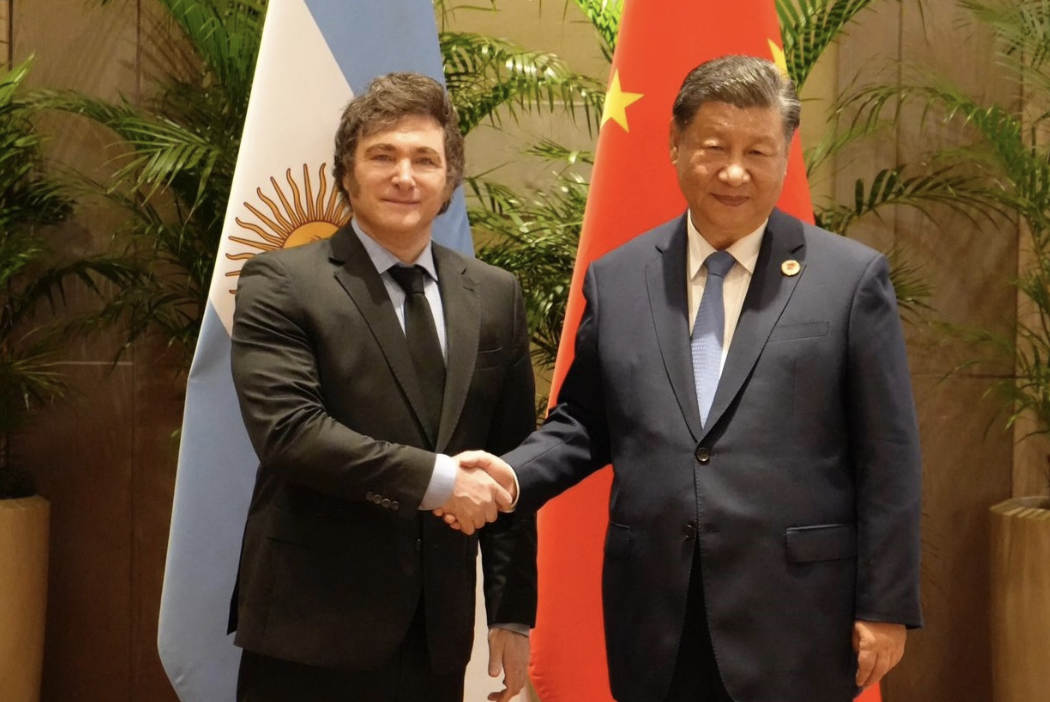
Image: Argentine President Javier Milei meets with Chinese President Xi Jinping in Rio de Janeiro, Brazil, on the sidelines of the G20 Summit in November 2024. (Image source: Office of the President of Argentina)
The political consequences of this framing has become particularly visible during the administration of President Milei. During his presidential campaign, Milei publicly criticized the PRC, stating he “would not do business with Communists,” and initially signaled the possibility of reorienting Argentina’s foreign policy toward closer alignment with the United States. Rumors of expanded engagement with Taiwan generated strong reactions among Argentine commentators and policymakers, some of whom warned that such engagement could jeopardize PRC financial cooperation, including currency swap agreements. Commentators also cautioned that closer ties with Taiwan could imperil Beijing’s diplomatic backing on the Malvinas issue.
Although the Milei Administration ultimately reaffirmed Argentina’s adherence to the One China principle, the episode illustrated the degree to which the Taiwan-Malvinas analogy constrains Argentina’s diplomatic flexibility. It also demonstrated how interaction with Taiwan continues to be treated as politically sensitive, despite Argentina already maintaining extensive economic and cultural ties with Taiwan.
Today, Taiwan functions as any other self-governing democratic country with autonomous institutions, competitive elections, its own armed forces, passport system, and independent economic administration. Since the Malvinas and Taiwanese disputes are not synonymous, the mere presence of a sovereignty issue surrounding Taiwan should not deter Argentina from expanding trade, technology, education, investment, and scientific cooperation with the island. Rather, greater engagement could complement Milei’s objectives of attracting investment, strengthening human capital, diversifying technological partnerships, and deepening relations with economies in the Indo-Pacific region.
Toward a More Pragmatic Foreign Policy
The comparison between Malvinas and Taiwan is ultimately a flawed equivalence that obscures the distinct historical, legal, and geopolitical dimensions of both issues. Treating these cases as interchangeable oversimplifies the differences between them, and creates unnecessary constraints on Argentina’s foreign policy.

Image: Former Argentine Congressman José Luis Espert (second from left) meets with Taiwanese Representative to Argentina Florencia Miao-hung Hsie (second from right), accompanied by Counsellor Roger Li (left) and Federalism and Freedom Foundation founder José Guillermo Godoy (right). (Image source: X/José Luis Espert)
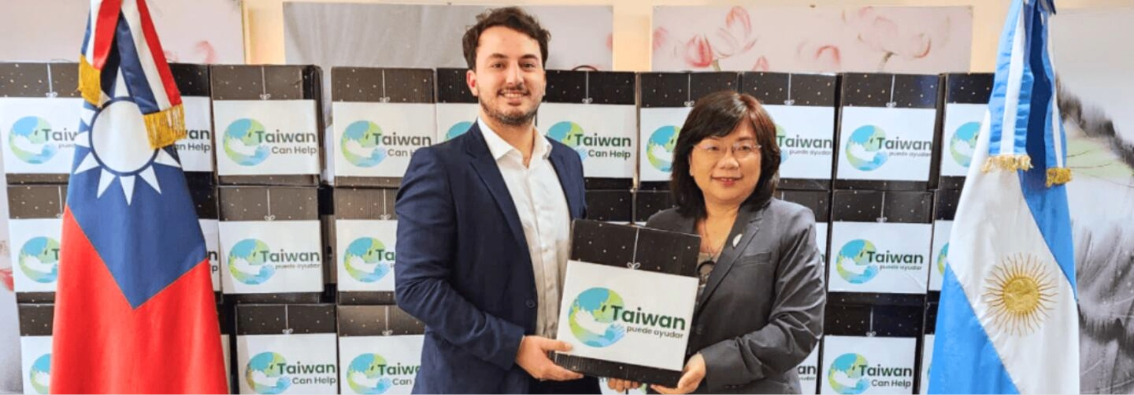
Argentina already engages with Taiwan through economic, academic, and cultural activity, while at the same time recognizing the PRC. However, excessive political sensitivity surrounding engagement with Taiwan constrains Argentine opportunities of cooperation. For instance, Taiwanese humanitarian assistance for basic necessities to vulnerable communities have drawn criticism that such engagement could undermine China’s support for Argentina’s Malvinas claim. Similarly, meetings between Taiwan’s representative and Argentine legislators have generated political backlash because of their perceived implications for relations with Beijing. Moreover, parliamentary exchanges have likewise remained politically sensitive, despite Taiwan’s invitations for Argentine members of Congress to participate in exchange visits.
Engaging with Taiwan should be interpreted as part of a broader strategy of diversified international engagement and foreign policy flexibility. Indeed, expanding unofficial engagement with Taiwan preserves Buenos Aires’ room for diplomatic maneuver–and, ultimately, allows Argentina to enhance its own sovereignty.
The main point: Argentina can maintain its Malvinas claim while expanding economic, technological, and cultural ties with Taiwan. Equating sovereignty disputes over the Malvinas and Taiwan is analytically flawed and generates missed opportunities in bilateral relations between the two nations.
[1] The principle of uti posseditis iuris holds that independent states retain the territorial boundaries of the colonial administrative units from which they emerged. The principle has been recognized in international jurisprudence as a means of preserving the territorial status quo at the moment of decolonization and, importantly, of giving precedence to legal title over mere effective possession.