
Shoppers in the United Kingdom and France got a treat when supplies of fresh fruit from Taiwan found their way onto their supermarket shelves for the first time this year. The first batch, a mixed shipment of premium Irwin mangoes from Tainan and black-leaf lychees from Taichung, cleared customs in the British city of Manchester in early June. Taiwan’s mangoes also arrived in France shortly thereafter, enjoying overwhelming popularity among French consumers despite the astonishing price tag of $29 USD per fruit. In less than a month, more than four tons of the fruit were sold out.
Getting an official permit to send Taiwan produce into Europe’s highly protected customs area is a complicated process. The region’s produce-related import regulations are highly restrictive, as they cover everything ranging from labelling and pesticide exposure, to how the produce can be marketed. Therefore, it marked a great achievement when the Taipei Representative Office in the European Union (EU) and Belgium announced in 2025 that it had received clearance for mango and guava imports, after “years of negotiations and technical preparations.” Approvals for lychees and dragon fruit followed eight months later.
Europe was not the only challenging destination for Taiwan’s fruit exports. Taiwan’s officials in agricultural sectors also sought to export pineapples to New Zealand. The endeavor began with the signing of the Agreement between New Zealand and the Separate Customs Territory of Taiwan, Penghu, Kinmen, and Matsu on Economic Cooperation
(ANZTEC, 紐西蘭與臺澎金馬個別關稅領域經濟合作協定) in 2013. Eight years of bilateral negotiations on the amendments to ANZTEC finally opened New Zealand’s doors to premium Taiwan pineapples. In May of 2025—two years after the ANZTEC revisions were approved—the first batch of Taiwan’s pineapples arrived in the New Zealand market.
Reducing Dependence on a Single Market
In 2010, around the time of Taiwan’s accession into the World Trade Organization (WTO), the island’s fruit began losing competitiveness in many of its traditional markets, which included Japan and the Philippines. As Taiwan’s agricultural industry scrambled in the face of new international competition, the Cross Straits Economic Cooperation Framework Agreement (ECFA, 海峽兩岸經濟合作架構協議) created an opportunity for Taiwan’s fruit, resulting in a huge jump in exports into a single market: China.
ECFA was a gift for Taiwanese farmers. Two years after it was promulgated, Taiwan’s total agricultural exports increased more than eight percent. Particularly, fruit exports to China grew 42 percent; and produce on the early harvest list, such as bananas, hami melons, lemons, and red dragon fruits, surged 42 percent compared to 2007.
Nevertheless, the agricultural trade protected by ECFA did not last. In February and September 2021, China abruptly ended its imports from Taiwan—first pineapples, then sugar apples and wax apples—claiming that inspections had discovered citrus mealybugs in a number of shipments.
ECFA critics say China was not a viable long-term market to begin with. China started growing and cultivating what used to be Taiwan’s signature fruits, eroding demand for Taiwan’s exports. Additionally, Beijing began to use fruit imports as a figurative stick to bring Taiwan to heel. Huai-Shing Yen (顏慧欣) of the Chung Hua Institution for Economic Research (中華經濟研究院) had warned of the need to reduce Taiwan’s reliance on the Chinese market, writing that: “The high concentration structure (of exports to China) makes it certain that the import restrictions will have a commercial impact on relevant farmers in Taiwan. As such, China’s actions to restrict imports are loud reminders of the vulnerability that this ‘export dependence’ causes for these agricultural products.”
Yen also warned that even if Taiwan had sought to seek redress for China’s actions through the WTO, China “would not be obliged to enter consultations or negotiations with Taiwan.” Instead, Taiwan should seek alternatives, more reliable markets for its products. Weeks after China’s sugar apple and wax apple ban, the then-Council of Agriculture (COA, 行政院農業委員會) announced a strategy that sought to capitalize on existing and potential demand for Taiwanese fruit both inside and outside the country.
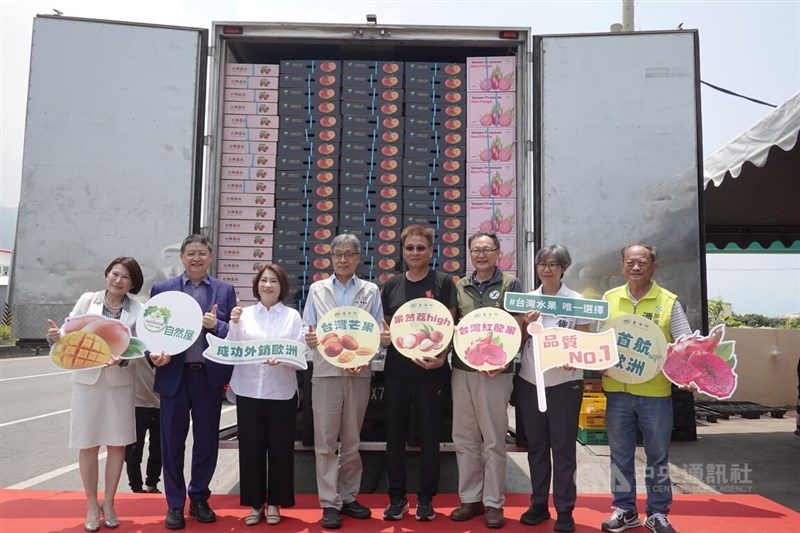
Image: Local officials in Pingtung County (southeastern Taiwan) pose with a shipment of various fruits— mangoes, lychees, and dragon fruit—bound for shipment to Europe under the terms of new trade agreements with the European Union (June 2026). (Image source: Central News Agency)
Cold Chain Logistics: The Unsung Hero
Today, Taiwanese fruit is sold at a premium in supermarkets and specialty retailers in numerous countries, such as Japan, South Korea, Australia, Canada, Singapore, Hong Kong, Malaysia, Brunei and Palau—but the produce would not have made it beyond its shores without advancements in Taiwan’s cold chain logistics industry.
The Industrial Technology Research Institute (ITRI, 工業技術研究院), a non-government R&D organization that incubated Taiwan’s semiconductor industry, has been dedicated to the development of cold chain logistics since the 1990s. Janet Chen (陳慧娟), General Director of ITRI’s Service Systems Technology Center, told this author that there are similarities to transporting fruit and semiconductors, as they both have strict requirements in temperature, humidity, and cleanliness: “Agricultural products must be kept within appropriate temperature and humidity ranges to slow deterioration and preserve freshness and nutritional value. Semiconductor components may also be sensitive to temperature and humidity. Clean storage and transportation environments help prevent cross-contamination and microbial growth in agricultural cold chains. Semiconductor manufacturing requires exceptionally clean environments because even microscopic particles can cause defects.”
Chen adds: “Freshness is a major source of value for agricultural products, making timely delivery essential. Semiconductor supply chains also require fast and reliable transportation because delays may lead to missed business opportunities, inventory shortages, or production disruptions. Agricultural cold chains require traceability from farm to table to support food safety and quality control.” [1]
Government Ensures Taiwan’s Fruit is Compliant
The Ministry of Agriculture (MOA, 農業部) has also ensured that fruit exports comply with regulations that differ from territory to territory. For instance, mangoes heading to Europe must be subjected to heat treatment to kill off any pests or microbial hitchhikers, while pineapples bound for New Zealand must be harvested at a specific life stage. This is not to mention the various pesticide standards set in overseas markets.
To support Taiwan’s farmers, the MOA and local governments in 2024 inaugurated a processing park in Yujing District in Tainan, which can process mango and pineapple to meet international standards. Its Produce Processing and Cold Chain Logistics Center (玉井農產加工及冷鏈物流中心) is equipped with pre-cooling, processing, refrigeration, and freezer zones capable of processing as much as 800 tons of mangoes a year.
External uncertainties highlight the significance of transport quality control. Kris Tang, General Manager of fruit exporter Sunray Fresh (昇睿鮮農), revealed to this author that during their first commercial shipment, fruit travelled via Frankfurt in the midst of a staffing shortage and a heat wave. “The mango and lychee could not be placed on the same onward flight to the UK and had to arrive separately. (By then), our priority was not simply to preserve the original schedule, but to protect the quality and integrity of the products.” [2]
Gaining entry into Europe’s market is a good start—but more needs to be done if Taiwanese farmers are to cut their reliance on the Chinese market entirely. Focus Taiwan has reported that the Taiwan still sold USD 370 million worth of fresh fruit to Hong Kong and China from 2020 to May 2026, while exports to Japan totaled USD 199.4 million during the same period.
But exporters know that getting a foothold is just the first, albeit critical step. Tang told this author: “The first shipment was important, but it was only the beginning. What matters is whether we can create a repeatable and commercially sustainable route that allows more Taiwanese fruit and agricultural products to enter the UK and, eventually, the wider European market.” [3]
The main point: Taiwan’s move away from relying on a handful of traditional export markets like China has opened new doors for its fruit exports. That pivot, which also resulted in new technological innovation within Taiwan’s cold-chain logistics system, opened new markets in Europe for Taiwan’s mangoes and lychees. Developing its fruit market has also paved the way for Taiwan’s exports beyond high-tech products.
[1] Author’s interview, summer 2026.
[2] Author’s interview, summer 2026.
[3] Ibid.