
On March 30, the Chinese Communist Party (CCP, 中国共产党) publicly announced that it had extended an invitation to Cheng Li-wun (鄭麗文), the chairperson of Taiwan’s opposition Kuomintang Party (KMT, 國民黨), to lead a KMT delegation visit to the “mainland” (大陆) [i.e., the territory of the People’s Republic of China (PRC)]. The move had been widely rumored in Taiwan since Cheng’s election as KMT party chair in a party primary held in October 2025—following which Cheng quickly distinguished herself as an outspoken and controversial figure, in terms of both opposition to the Democratic Progressive Party (DPP, 民主進步黨) administration of Taiwan President Lai Ching-te (賴清德), and her advocacy for friendlier ties with the PRC. The same day, the KMT chair’s office announced acceptance of the invitation—employing language that, in some aspects, closely echoed CCP narrative language about Taiwan. [1]
The KMT central party office followed up with announced plans for a “2026 Peace Trip” (2026 和平之旅), to “proceed on the basis of goodwill, upright concepts, and peace” (本著善意、正念、和平出發). The trip would be led by Chairperson Cheng, accompanied by a large delegation of 14 total persons: including key members of the KMT such as Vice Chair and Secretary-General Lee Chien-lung (李乾龍), Vice Chair Chang Jung-kung (張榮恭), Vice Chair Hsiao Hsu-tsen (蕭旭岑), and Central Council Presidium Chairman Su Chi (蘇起). [Su Chi was the former Minister of the Mainland Affairs Council from 1999-2000, who coined the term “1992 Consensus” (九二共識).] [2]
Cheng Li-wun and the rest of the KMT delegation conducted their trip from April 7-12, with meetings and site visits in Shanghai, Nanjing, and Beijing—to include meetings with senior CCP officials including CCP Taiwan Affairs Office Director Song Tao (宋涛) and CCP General Secretary Xi Jinping (习近平). The trip has proven to be highly controversial in Taiwan, and even within Cheng’s own Kuomintang Party— revealing cleavages between “deep blue” KMT members favoring closer ties with Beijing, and more moderate members uneasy with the KMT leadership’s open cultivation of the PRC’s Communist rulers. The trip also highlighted Beijing’s approach to dealing with Taiwan: organized on a party-to-party as opposed to a state-to-state basis, the trip further illustrated the CCP’s refusal to deal with Taiwan’s allegedly “separatist” DPP-led presidential administration, while seeking to cultivate contacts with the KMT opposition party.
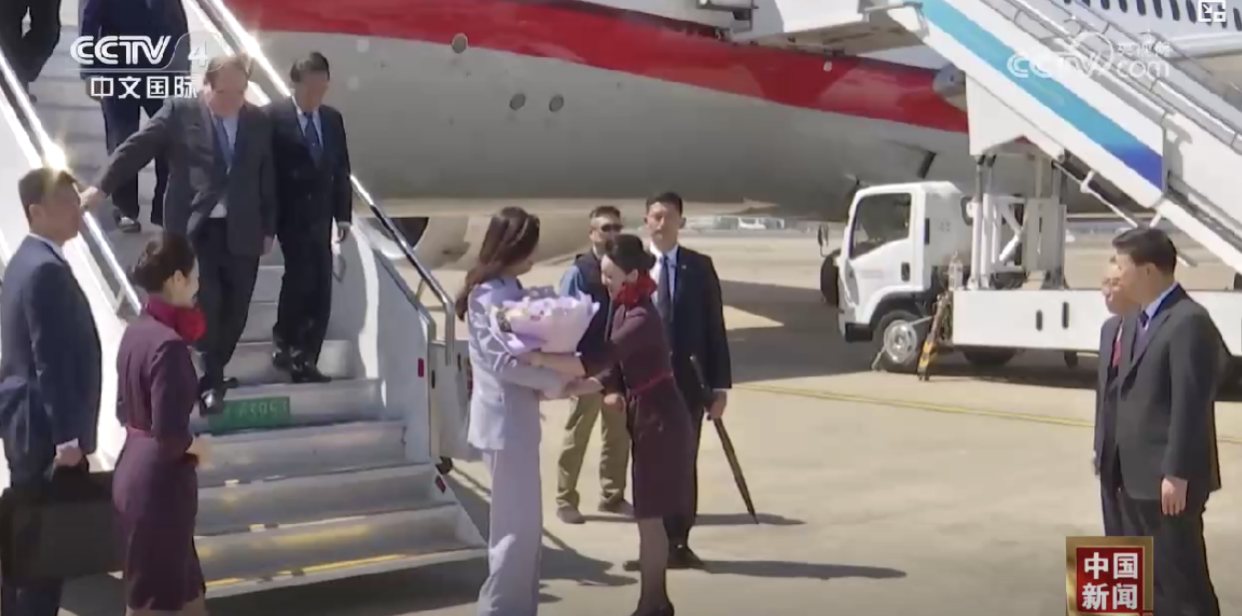
Image: KMT Chair Cheng Li-wun (center, holding flowers) is greeted by government officials upon arrival in Shanghai. Song Tao (far right), director of the CCP Taiwan Affairs Office, was among the delegation greeting Cheng upon her arrival (April 8, 2026). (Image source: CCTV)
The Itinerary of the KMT Delegation Trip
The “2026 Peace Trip” by the KMT delegation to China ran from April 7 to April 12, 2026. The itinerary was as follows:
Date | City | Significant Trips and Meetings on the Schedule |
April 7 | Shanghai, Nanjing |
|
April 8 | Nanjing, Shanghai | |
April 9 | Shanghai |
|
April 10 | Beijing |
|
April 11 | Beijing |
|
April 12 | Beijing |
|
A few stops during the trip were particularly noteworthy for their political significance. On April 8, the delegation visited the Sun Yat-sen Mausoleum in Nanjing to pay tribute to Sun Yat-sen (Sun Zhongshan, 孫中山), the founding father of the Republic of China and a foundational figure in the history of the KMT. Such visits are customary for KMT leaders traveling to China: for example, former President Ma Ying-jeou (馬英九) paid respects at Sun’s mausoleum during a spring 2023 trip to China. However, Cheng distinguished herself from her predecessors through provocative remarks delivered after the ceremony. In her speech, Cheng repeatedly referenced Japan, tracing the origins of current cross-Strait divisions to the First Sino-Japanese War; and portraying Japan as both a colonial ruler of Taiwan, and a participant in imperialism and aggression during the Second World War. This framing aligns with Beijing’s recent rhetorical posture, which emphasizes Japan’s alleged role in interfering in cross-Strait affairs and stoking regional tensions.
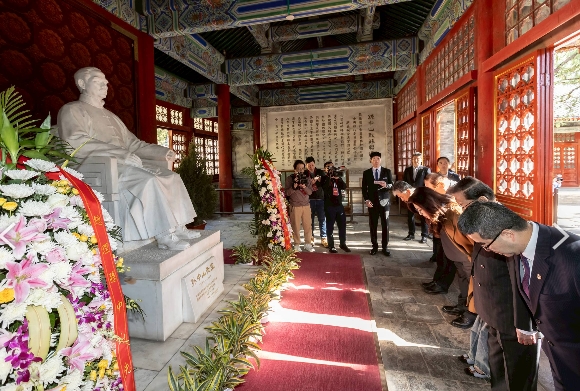
Image: The visiting KMT delegation paying respects at a memorial to KMT founder Sun Chung-shan (Sun Yat-sen) at the Bi Yun Temple (碧雲寺) in the western suburbs of Beijing (Apr. 11, 2026). (Image source: KMT Official Website)
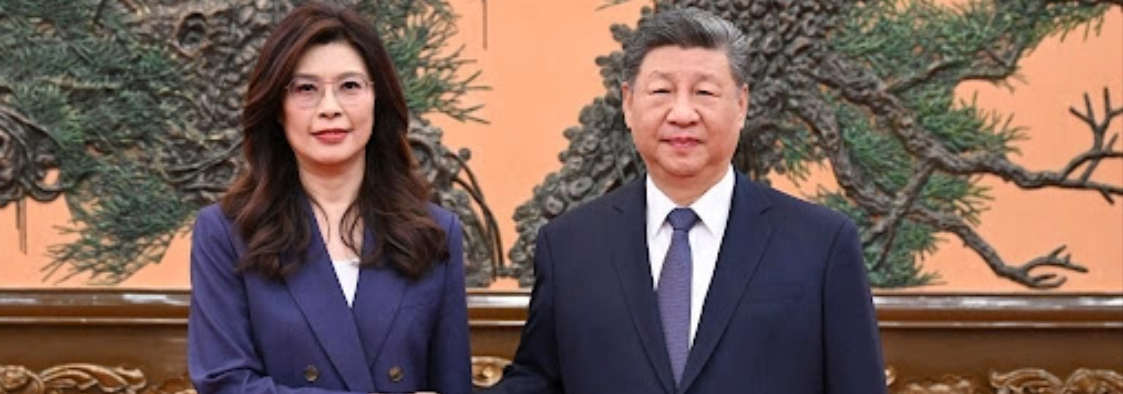
On April 10, Cheng was granted an audience with CCP General Secretary Xi Jinping at Beijing’s Great Hall of the People (人民大會堂). Xi Jinping was accompanied by four senior figures from the Chinese Communist Party : Wang Huning (王沪宁), chairman of the National Committee of the Chinese People’s Political Consultative Conference (CPPCC, 中国人民政治协商会议); Cai Qi, director of the CCP General Office (蔡奇); Song Tao, director of the Taiwan Affairs Office; and Zheng Shanjie (郑栅洁), chairman of the National Development and Reform Commission (中华人民共和国国家发展和改革委员会). The CPPCC serves as the PRC’s top advisory body and plays a key role in advancing ideological outreach through united front work (統一戰線工作), with Wang Huning holding the Politburo Standing Committee (PBSC, 中国共产党中央政治局常务委员会)’s united front policy portfolio. Cai Qi and Song Tao likewise hold influential positions within the party-state apparatus: both Wang and Cai are members of the PBSC—the CCP’s highest decision-making body—ranking fourth and fifth, respectively, while Song oversees Taiwan policy through the CCP Taiwan Affairs Office.
Another highlight of the trip was a series of visits focused on technology and artificial intelligence. Reflecting Beijing’s broader effort to present itself as a global technology powerhouse, the itinerary included site visits to major companies and research institutions. On April 8, the delegation toured the headquarters of Meituan, a top on-demand delivery company in China, where they experienced food delivery service conducted by AI-powered drones. This was followed by visits to AI laboratories in Tsinghua University High School on April 10, Zhongguancun Exhibition Center on April 11, and Xiaomi car factories on April 12. According to Cheng, some of these visits—particularly those to Tsinghua University High School and Zhongguancun—were made at her request, as she indicated that Taiwan should learn from China’s experience in adopting technological innovation and general artificial intelligence to overcome the “middle-income trap.” Cheng’s language echoes a common narrative promoted by Chinese state media regarding Chinese economic and technological advancement.
Cheng Li-wun’s Narrative Messaging During the Trip
While in Beijing, Cheng framed cross-Strait relations in stark terms, stating that “[the KMT is] seeking an institutional solution to prevent war.” This language points towards the idea of a structured framework governing relations between Beijing and Taipei through party-to-party contacts. In addition, Cheng characterized cross-Strait relations as a “choice between peace and war.” While Cheng didn’t talk about defense issues directly, this framing could be seen as indirectly commenting on the Taiwanese government’s recent push to increase defense spending—which Beijing has portrayed as contributing to heightened tensions.
Cheng further emphasized that the “the Taiwan Strait won’t be a focal point of potential conflict anymore, and won’t be a chessboard of external interference.” With such statements, Cheng both aligned with Beijing’s framing of cross-Strait issues as an internal issue, and obliquely referenced the “abandoned chess piece” narrative about US-Taiwan relations that is a staple of CCP propaganda. Cheng further invoked CCP talking points in a speech in Shanghai where she blamed Japan and the West as negative influences on cross-Strait peace. (It has long been a CCP talking point to look to Japanese aggression as one of the central causes of China’s “Century of Humiliation.”) In addition, Cheng has cast her own identity as Chinese, connecting to Chinese messaging that both sides of the Taiwan Strait are Chinese. These themes closely mirror CCP messaging—particularly in their emphasis on sovereignty issues, historical grievances, and framing Taiwan as a Chinese internal matter. [3]
Cheng’s comments are also significant in the context of Taiwan’s ongoing debate over a proposed supplemental defense budget. With the framing of her visit to China as offering “institutional solutions,” presented in the context of a “peace versus war” dichotomy, Cheng appears to raise the question as to whether increased defense spending is needed at all. This feeds into domestic political controversies in Taiwan, where the supplemental defense budget has become a proxy debate for cross-Strait strategy, identity politics, and public trust in the different political parties.
The PRC State Media Commentary Seeks to Leverage Cheng’s Visit
As would be expected for any such high-profile event, PRC state-controlled media has sought to leverage the trip to reassert the CCP’s narratives regarding Taiwan and “reunification” with the island. (Such was also the case with similar CCP-hosted trips to China undertaken by Ma Ying-jeou in 2023 and 2024.) Two themes invoked repeatedly in PRC media—as in a speech presented by Xi at the April 10 meeting—were the need to “uphold the 92 Consensus” (坚持“九二共识”) and “oppose Taiwan separatism” (反对“台独”). These are themes that Cheng Li-wun herself has stressed in public commentary in early 2026, marking a striking alignment between KMT and CCP messaging.
The CCP has also attempted to leverage Cheng’s trip to reassert longstanding united front policies advocating for closer economic ties between Taiwan and the PRC, as a preparatory step towards ultimate unification. On April 12, just as the KMT delegation trip concluded, the CCP Taiwan Affairs Office announced “10 Political Measures for Advancing Cross-Strait Exchange and Cooperation” (十项促进两岸交流合作的政策措施). These measures are as follows:
- “Explore mechanisms for normalizing communication mechanisms between the CCP and KMT” (探索建立国共两党常态化沟通机制) “on the basis of upholding the ’92 Consensus’, opposing ‘Taiwan independence’ [and] adhering to the concept of ‘both sides of the Strait are one family’.”
- “Establish KMT-CCP Bidirectional Youth Exchange Mechanism Platforms” (建立国共两党青年双向交流机制化平台). [4]
- “In areas of coastal Fujian where conditions allow, promote water, electricity, and gas connections with Kinmen and Matsu” (推动福建沿海地区在条件具备情况下同金门、马祖通水、通电、通气、通桥).
- “Promote the comprehensive renewal of the normalization of cross-Strait passenger aviation direct flights” (推动全面恢复两岸空中客运直航正常化), with added direct flights between Taiwan and Urumqi, Xian, Harbin, Kunming, and Lanzhou; as well as shared use by Kinmen of the new airport at Xiamen.
- “On the political foundation of upholding the ’92 Consensus’ and opposing ‘Taiwan independence’, establish mechanisms for communication” (在坚持“九二共识”、反对“台独”政治基础上建立沟通机制), [and] “in accordance with inspection and quarantine standards, offer benefits to Taiwan farmers and fishermen in introducing their products into the mainland.”
- “Improve cross-Strait fisheries access management” (完善涉台渔业准入管理), including access for Taiwan fishing boats in Chinese ports.
- “Facilitate Taiwan food production enterprises registering in the mainland, and Taiwan food products entering the mainland [market]” (台湾食品生产企业在大陆注册和台湾食品输入大陆提供便利)
- “Research how localities meeting requirements may establish small goods trading markets” (研究在有条件的地方新设对台小额商品交易市场), for Taiwan medium and small enterprises to open up access to mainland markets.
- “Allow Taiwan television dramas, documentary films, cartoons, etc. – which follow correct guidance, have healthy content, and are of superior quality – to be viewed on mainland satellite channels and internet” (允许引进导向正确、内容健康、制作精良的台湾电视剧、纪录片、动画片在大陆卫视频道和网络视听平台播出).
- “Promote resumption of the experimental program for travel to Taiwan (the main island) for residents of Shanghai and Fujian provinces” (推动恢复上海市及福建省居民赴台(本岛)个人游试点).
Most of the listed 10 measures are not really new, and reflect longstanding CCP efforts to dangle vague promises of economic benefits (especially for fishermen and farmers) as an incentive for embracing cross-Strait integration. Item #4 is interesting in terms of the proposed increased number of flights connecting Taiwan more directly with cities deep in the interior of the PRC. Arguably, the most interesting measure is item #9, pertaining to promised wider access to Taiwan entertainment products in the huge Chinese market. However, the stipulation that such media products must “follow correct guidance” and “have healthy content”—meaning that they must adhere to CCP censorship directives—would be a significant stumbling block.
The Political Controversies within Taiwan over the KMT Delegation Trip
The KMT delegation trip has been highly controversial within Taiwan itself, highlighting many of the differences that exist between Taiwan’s major political parties—and in some cases, even within those parties—over not only questions of cross-Strait policy, but also of national identity.
The Democratic Progressive Party—which controls Taiwan’s executive branch, but is in the minority in the legislature—has been sharply critical of the delegation visit, criticizing the KMT leadership on alleged grounds of embracing CCP propaganda narratives, and promoting a “manufactured consensus” about Taiwan’s sovereignty status. [5] The government’s Mainland Affairs Council has also criticized the trip, with Minister Chiu Chui-cheng (邱垂正) stating on April 10 that: “Chairman Cheng Li-wun’s ‘peace framework’ is really a ‘unification framework.’ The institutionalization of cross-Strait peace is Beijing’s ‘One Country, Two Systems’ plan for Taiwan. For the Chinese Communist Party, only when Taiwan accepts ‘One Country, Two Systems’ and the Republic of China ceases to exist will it stop its military intimidation and make peace.”
Internal Divisions within the KMT
While criticism of the trip from government ministries and the DPP would be expected, it is also striking how Cheng’s trip has exposed internal divisions within the KMT regarding the best path forward for cross-Strait relations. Taipei Mayor Chiang Wan-an (蔣萬安), who is running for reelection as the KMT candidate, distanced himself from Cheng’s proposal for an institutional framework by stating that “Cheng is proposing her own opinion” rather than expressing official policy. Chiang has also avoided adopting Cheng’s language on identity, stating instead that he is “Taiwanese, a ROC national”—which is more aligned with the KMT’s post-democratization identity framing, which emphasizes the Republic of China while accommodating a Taiwanese identity. At the same time, Chiang has remained positive on cross-Strait communications: for example, during last year’s Taipei-Shanghai Twin City Forum (臺北-上海城市論壇), Chiang’s remarks highlighted his preference for engagement between the two sides of the Taiwan Strait.
While Chiang’s remarks can be seen as more cautious, Taichung Mayor Lu Shiow-yen (盧秀燕) is more assertive. Mayor Lu, a likely contender to be the KMT’s presidential candidate for 2028, has been more explicit on defense preparedness, supporting a significantly higher supplemental defense budget range than the KMT caucus in the legislature. She also met with Cheng prior to her trip to China to discuss the supplemental defense budget, suggesting some effort to achieve coordination on messaging. Lu’s willingness to back an increased supplemental defense spending highlights a more security-oriented faction within the KMT, showcasing the party’s internal divisions over how to balance engagement with deterrence regarding China.
Conclusion
The KMT delegation trip illustrates a number of important issues within both cross-Strait relations and Taiwan’s domestic politics. The first of these is the continuing effort by the CCP to bypass official government channels in dealing with Taipei: shutting out ministries run by the “separatist” DPP, and preferring instead to deal on a party-to-party basis with the KMT—and furthermore, treating the KMT as if it were the sole and (semi) legitimate representative of the “Taiwan regional authorities.” It also demonstrates the eagerness of at least some in the more “deep blue” side of the KMT to take up the offer. Previous high-profile trips such as those taken by Ma Ying-jeou were clearly used to advocate for closer cross-Strait ties, and for a sense of shared Chinese identity—but they were framed as private, not official, trips. By contrast, Cheng’s framing of the trip as building “institutional solutions” for cross-Strait relations veers close to asserting a right for her faction of the KMT to negotiate on behalf of Taiwan.
Cheng and her advisors are also promoting positions that resonate poorly in Taiwan: the “92 Consensus” and “One Country, Two Systems” are both unpopular positions (see here and here), and polling data has consistently shown that Cheng’s avowed strong sense of Chinese identity is a minority position among her fellow citizens. This explains the apparent discomfort towards Cheng’s trip displayed by other, more moderate KMT political figures, and their efforts to distance themselves from it.
Based on the March 2026 Foreign Affairs article published under Cheng’s name, and her comments related to a planned summer 2026 visit to the United States, it appears that Cheng is attempting some version of what KMT interlocutors have called “using both legs to walk down the street” (用兩條腳走路)—that is, balancing relations between the PRC and the United States. However, the effort to curry favor in Beijing runs the dual risk of naively playing into CCP united front work, while alienating voters in Taiwan who are left cold by the Chinese identity messaging of the “deep blue” KMT. While Cheng’s trip was certainly successful in raising her own controversial profile, it remains doubtful whether any meaningful “institutional solutions” were actually created for the intractable disputes shaping cross-Strait relations.
The main point: KMT party chair Cheng Li-wun led a week-long delegation trip to the PRC in early April, visiting both economic and historical sites in China and holding meetings with senior CCP officials. While the messaging surrounding the “2026 Peace Trip” promoted the idea that it was building institutional solutions for cross-Strait disputes, the trip has been politically controversial in Taiwan, including within the KMT itself.
[1] The KMT central office statement indicated “Earnest hope that the two parties may make great efforts together to advance cross-Strait relations [and] peaceful development, promote cross-Strait exchanges and cooperation, consult on peace in the Taiwan Strait, [and] increase benefits for the people’s livelihood”
(期望兩黨共同努力,推動兩岸關係和平發展,促進兩岸交流合作,為台海謀太平、為民生增福祉.) In particular, the language about advancing “peaceful development” and “promoting cross-Strait exchanges and cooperation” hews very closely to CCP boilerplate propaganda messaging related to Taiwan. The similarity of such language raises questions regarding the process by which the statement was written.
[2] The full delegation consisted of the following persons: KMT Chairperson Cheng Li-wun; Vice Chairperson and Secretary-General Lee Kan-lung; Vice Chairperson Chang Jung-kung; Vice Chairperson Hsiao Hsu-tsen; National Policy Foundation Vice Chairman Lee Hung-yuan; Central Council Presidium Chairman Su Chi; Central Council Presidium Chairman Yuan Chien-sheng; Chairperson’s Special Advisor Lee Te-wei; Cultural Communication Committee Chairperson Yin Nai-ching; Mainland Affairs Department Director Chang Ya-ping; Youth Affairs Development Committee Chairperson Lien Sheng-wu; Spokesperson Chiang Yi-chen; International Affairs Department Director Tung Chia-yu; and Central Party Affairs Advisor Lei Hung-yi.
[3] It is worth noting that there is a notable shift in Cheng’s language when speaking to English language media: to the effect that she is committed to deepening US-Taiwan relations and is supporting Taiwan’s national defense. In an interview with NBC, Cheng displayed a friendly attitude towards the United States by stating “it’s very crucial and important for us to have solid US support for Taiwan.” Cheng has also indicated plans to visit the United States in June 2026, suggesting an attempt to balance ties with Beijing and Washington.
[4] Note: The cultivation of “Taiwan youth” has been a longstanding and consistent theme of CCP united front work, intended to encourage young adults from Taiwan to study and work in the PRC. For examples of previous GTI analysis on this topic, see here and here.
[5] DPP e-mail press release, “What the KMT Brought Home: Gift-Wrapped Extortion with a Political Price Tag” (April 16, 2026).