
Leaving a country does not always mean turning away from it. However, when the choice to leave is weaponized as propaganda against the place you came from, it becomes a more complex story. In the case of Taiwan, individual choices to relocate have become part of something much bigger—a deliberate, long-term campaign to redirect Taiwan’s human capital elsewhere. The Chinese government has set up a range of programs specifically meant to attract Taiwanese workers, scholars, and entrepreneurs, all backed by the resources only a state can provide.
Chinese Offers Lure Taiwan’s Top Talent Abroad
China describes its talent recruitment strategy as “building nests to attract phoenixes.” Some of the “phoenixes” the strategy is targeting are Taiwan’s engineers, researchers, and skilled workers. The nest that is being built is meant to hollow out Taiwan from the inside.
In 2018, Beijing introduced what it nicknamed the “31 Measures” (關於促進兩岸經濟文化交流合作的若干措施), a comprehensive program offering Taiwanese companies and professionals tax breaks and opportunities for research grants. In November 2019, Beijing followed up with the “26 Measures,” which opened up more areas of the Chinese economy to Taiwanese businesses and workers. The following year, it was reported that China recruited over 3,000 chip engineers from Taiwan in recent years. In 2020, it poached more than 100 engineers from TSMC alone. Although the number of Taiwanese nationals working in China dropped to 231,000 in 2024 (from over 400,000 before the pandemic), China is still the top destination for Taiwanese working abroad. This was strategic economic warfare marketed as better opportunities. As far back as 2011, Academia Sinica –Taiwan’s top research institution – warned that China and other neighbors were competing for talent “as if it were a war,” while Taiwan’s government was slow to respond.
The strategy works because it exploits a real problem. Since 2000, wages in Taiwan have stayed stagnant for sixteen years even as the economy grew. Now, a university graduate with experience might earn around USD $1,400 per month in real terms after adjusting for inflation. In Taipei, that is barely enough to cover the high cost of living. When Chinese firms offer double or triple the salary along with housing and benefits, it becomes a package of incentives that some Taiwanese professionals find hard to refuse.
Beyond personal economic calculation, there are also social and political costs to consider. In 2017, a young Taiwanese man working in Shanghai posted online that others should leave Taiwan for better opportunities abroad, and was immediately denounced as a “communist bandit.” The discussion turned into a political debate on loyalty. Some see those who leave Taiwan to work in China as abandoning Taiwan. Those who pursue opportunities in China feel judged for making practical economic decisions. This kind of social division within Taiwan is what benefits China most.
This is not just an issue of Taiwan competing with another country for talent. China’s recruitment efforts have state resources as backing and a clear political interest weakening Taiwan’s economic and technological advancement. By using job opportunities and education programs to try to pull talent away from Taiwan, China aims to deepen economic dependence and use that as support for unification inside Taiwan itself. The logic is simple: make Taiwan’s young people dependent on China economically, and convince them that Beijing provides a better future; and accordingly, Taiwan’s political will for independence will weaken naturally without China needing to fire a single shot.
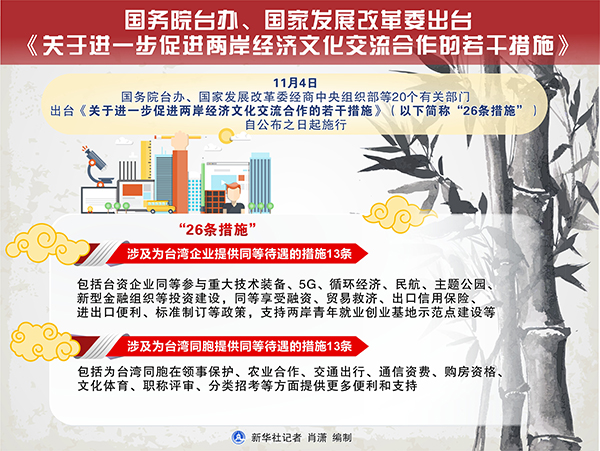
Image: A Chinese state media graphic extolling “Certain Measures Concerning the Advancement of Cross-Strait Economic and Cultural Exchange Cooperation” (關於促進兩岸經濟文化交流合作的若干措施), including economic incentive measures to recruit young adults from Taiwan to work in the PRC. (Image source: Xinhua News Agency)
Taiwan’s Demographic Problem
Taiwan has spent decades building one of the best education systems in Asia. It has poured money into universities and technical training to produce some of the most skilled engineers and researchers in the region. However, the challenge is to retain this talent in order to contribute to Taiwan’s economy, so that it is not running a talent factory for other countries’ economies.
Beyond emigration, there is also the larger demographic reality that Taiwan’s population is shrinking and aging rapidly with its consistent low birthrate. Taiwan’s total fertility rate has fallen to 0.8 children per woman, the lowest birthrate in the world. Only 135,000 babies were born in 2024. The population is projected to shrink from 23.4 million today to under 15 million by 2070. People over 65 already make up more than 20% of the population.
In this context, emigration of workers add stress to the economy and public services system. Fewer workers supporting more retirees could lead to higher taxes and weaker public services—which in turn, would give more people reason to leave. The cycle feeds itself in ways that become harder to break the longer it continues.
Taiwan’s Proven History of Thriving Under Tough Conditions
The current issues Taiwan faces are serious, but challenges are not unprecedented for Taiwan. This is a country that has transformed its economy more than once, often under more dire circumstances than what it faces now. The ability to rebuild has always been Taiwan’s hidden strength.
In the 1950s, economists looked at Taiwan’s situation with pessimism: seeing a country with limited natural resources, too many people on too little land, and a discredited government. Taiwan’s subsequent development proved them wrong. Between 1952 and 1982, Taiwan averaged 8.7% economic growth annually, transforming from an agricultural backwater into an industrial powerhouse. The gross national product grew 360% between 1965 and 1986 in what became known as the “Taiwan Economic Miracle.” When the 1997 Asian financial crisis swept through East Asia, Indonesia’s currency lost more than 75% of its value, South Korea’s fell about 46%, and Thailand’s dropped around 28%. Taiwan’s currency fell only 15%, and Taiwan emerged as one of the few economies that made it through the crisis without serious economic damage. Taiwan has had experience solving structural problems and remained resilient when the odds were against it.
Through decades of deliberate planning and painful reform, Taiwan was able to hold under pressure when other Asian economies failed. The question is whether Taiwan can summon that same capacity for structural change now, when the threat is not a sudden financial shock but two decades of wage stagnation and demographic decline that have led to many of its citizens to work elsewhere.
Taiwan doesn’t need a miracle. It needs to do what it’s already proven it can do, which is fix structural problems through concrete policy. That means wages that finally recover after two decades of going flat, housing policy that frees up the country’s empty apartments for people who don’t have family wealth, and real financial support for raising children rather than expecting young couples to absorb the full cost alone. Taiwan was able to become the indispensable hub of global semiconductor manufacturing through planning and investment.
Now, Taiwan needs to apply that same focus to keeping young talent from leaving. The government should raise wages competitively with what China and other countries offer. Housing costs should be manageable so that young professionals can afford to buy a place on their own salary. Small adjustments cannot fix big problems, so Taiwan needs to be thoughtful and innovative to have an integrated approach to tackle the problem of brain drain.
Taiwan’s Crisis Is Serious But Solvable
What kept Taiwan together through its hardest periods wasn’t just national identity or political will, though both mattered. It was the hope that staying meant opportunity and the promise that sacrifice came with the possibility of building something better.
People emigrating elsewhere is not Taiwan’s weakness. It serves as evidence that the problem is real and needs solutions. A 2020 survey of salaried workers found that 90% wished they could work abroad. That figure does not come from people who have given up on Taiwan. A lot of them are not chasing more money so much as the basic stability that an ordinary life in Taiwan once provided.
South Korea faced a similar brain drain in the 1980s, and this example could provide some lessons learned for Taiwan. Back then, South Korea’s best engineers and scientists were leaving for the United States. The government responded by pouring money into research and development, creating innovation hubs, and offering massive incentives for Koreans working abroad to come back. They made it financially attractive to return and built industries where top talent could actually thrive. Within two decades, South Korea went from losing talent to attracting it.
Taiwan has the resources and determination to do the same thing. Taiwan’s track record has proven that it is possible to overcome challenges to flourish and develop. Taiwan created an economic miracle with little natural resources, built a democracy from authoritarian rule, and developed a crucial semiconductor industry upon which the world depends. The talent exodus problem is serious, but not unsolvable. What Taiwan needs now is the same thing that got it through those earlier challenges: the recognition that this is an emergency, and the willingness to act like it.
The main point: Taiwan is gradually losing many of its most talented young workers to jobs overseas. The reason is not a lack of loyalty but a lack of opportunity, with wages that have stayed flat for twenty years and a cost of living that only goes up. For a generation that cannot afford homes or comfortably raise children, leaving has become a practical decision rather than an emotional one. The path forward is clear enough, because a country that built a semiconductor empire can certainly rebuild the conditions that keep its people home. Taiwan has solved difficult problems before – and with the right reforms, it can give its people a reason to build their lives at home.